
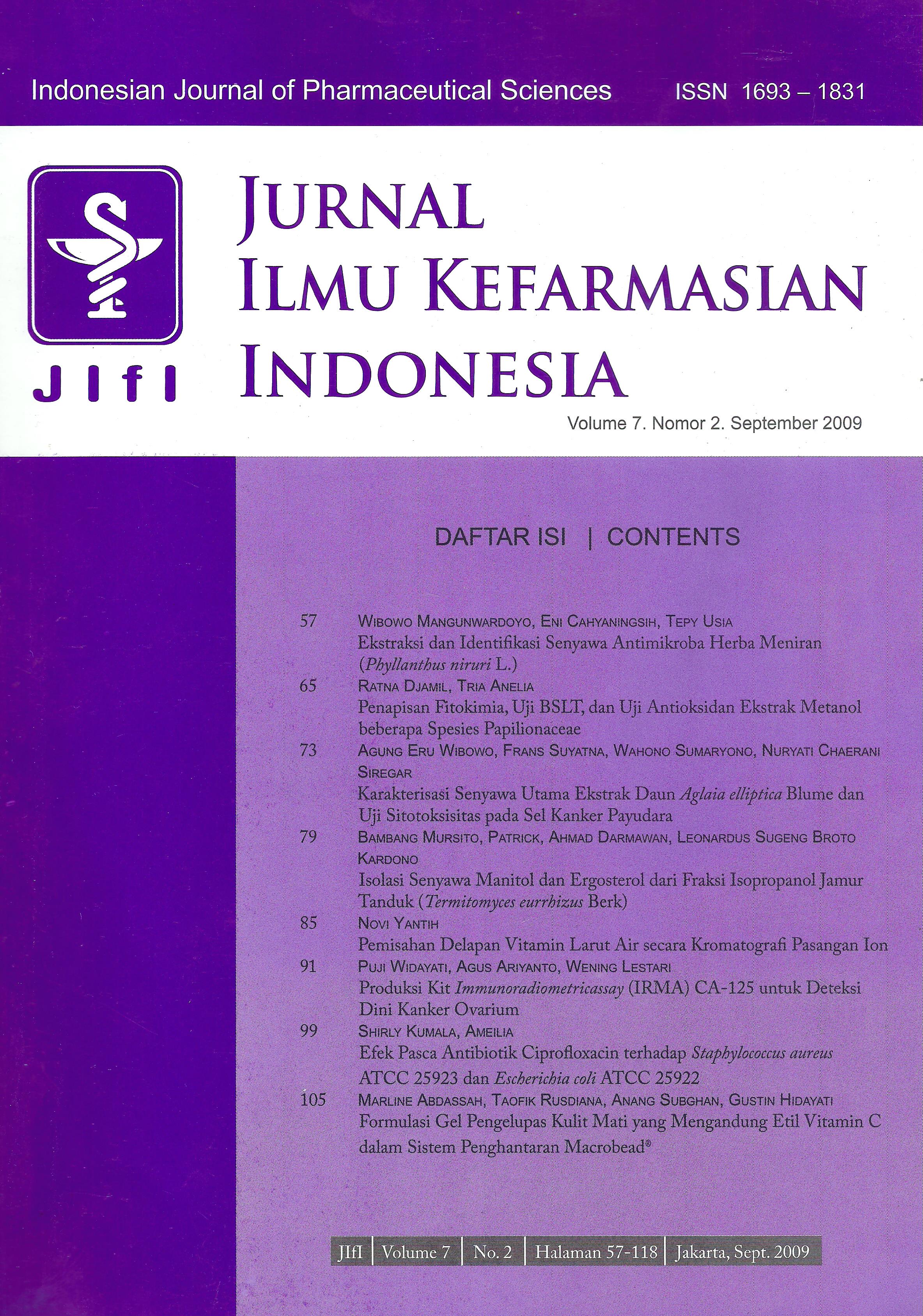
Produksi Kit Immunoradiometricassay (IRMA) CA-125 untuk Deteksi Dini Kanker Ovarium
Abstract
Ovarian cancer is the second highest incidence after cervix cancer, but has higher fatality level than cervix cancer. Generally, patient is known suffering ovarian cancer in very late stadium, III or IV, which is almost incurable. Cancer Would be easier to cure if detected early. In blood of ovarian cancer patient, Carbohydrate Antigen-125 (CA-125), an antigenic glycoprotein, is presence in a very low concentration initially and will increase proportionally with the level of malignancy. Therefore, early detection of ovarian cancer can be carried out by measurement of low level CA-125 in the blood. The most suitable method for the measurement is immunoradiometricassay (IRMA). Our laboratoryhas developed CA-125 IRMA kit since 2003, at first in form of CA-125 IRMA kit components that consisted of 125I-CA-125 tracer, CA-125 standard, and monoclonal antibody-coated tubes. We then made assay optimization of the IRMA CA-125 kit which gave B/T value of 19.05%, NSB value of 0.53% and Working area of 0 to 200 mIU/mL. Our further Works on validation of IRMA CA-125 kit using high and low concentration quality control (QCH and QCL) showed an intra assay (n=15) CV value of 9.9% for QCL and 2.97% for QCH, While inter assay (n=7) CV value of 13.1% and 4.9% for QCL and QCH respectively. The results comply with the IAEA protocol requirement.
References
Downloads
Published
Issue
Section
License
Licencing
All articles in Jurnal Ilmu Kefarmasian Indonesia are an open-access article, distributed under the terms of the Creative Commons Attribution-NonCommercial-ShareAlike 4.0 International License which permits unrestricted non-commercial used, distribution and reproduction in any medium.
This licence applies to Author(s) and Public Reader means that the users mays :
- SHARE:
copy and redistribute the article in any medium or format - ADAPT:
remix, transform, and build upon the article (eg.: to produce a new research work and, possibly, a new publication) - ALIKE:
If you remix, transform, or build upon the article, you must distribute your contributions under the same license as the original. - NO ADDITIONAL RESTRICTIONS:
You may not apply legal terms or technological measures that legally restrict others from doing anything the license permits.
It does however mean that when you use it you must:
- ATTRIBUTION: You must give appropriate credit to both the Author(s) and the journal, provide a link to the license, and indicate if changes were made. You may do so in any reasonable manner, but not in any way that suggests the licensor endorses you or your use.
You may not:
- NONCOMMERCIAL: You may not use the article for commercial purposes.

This work is licensed under a Creative Commons Attribution-NonCommercial-ShareAlike 4.0 International License.













