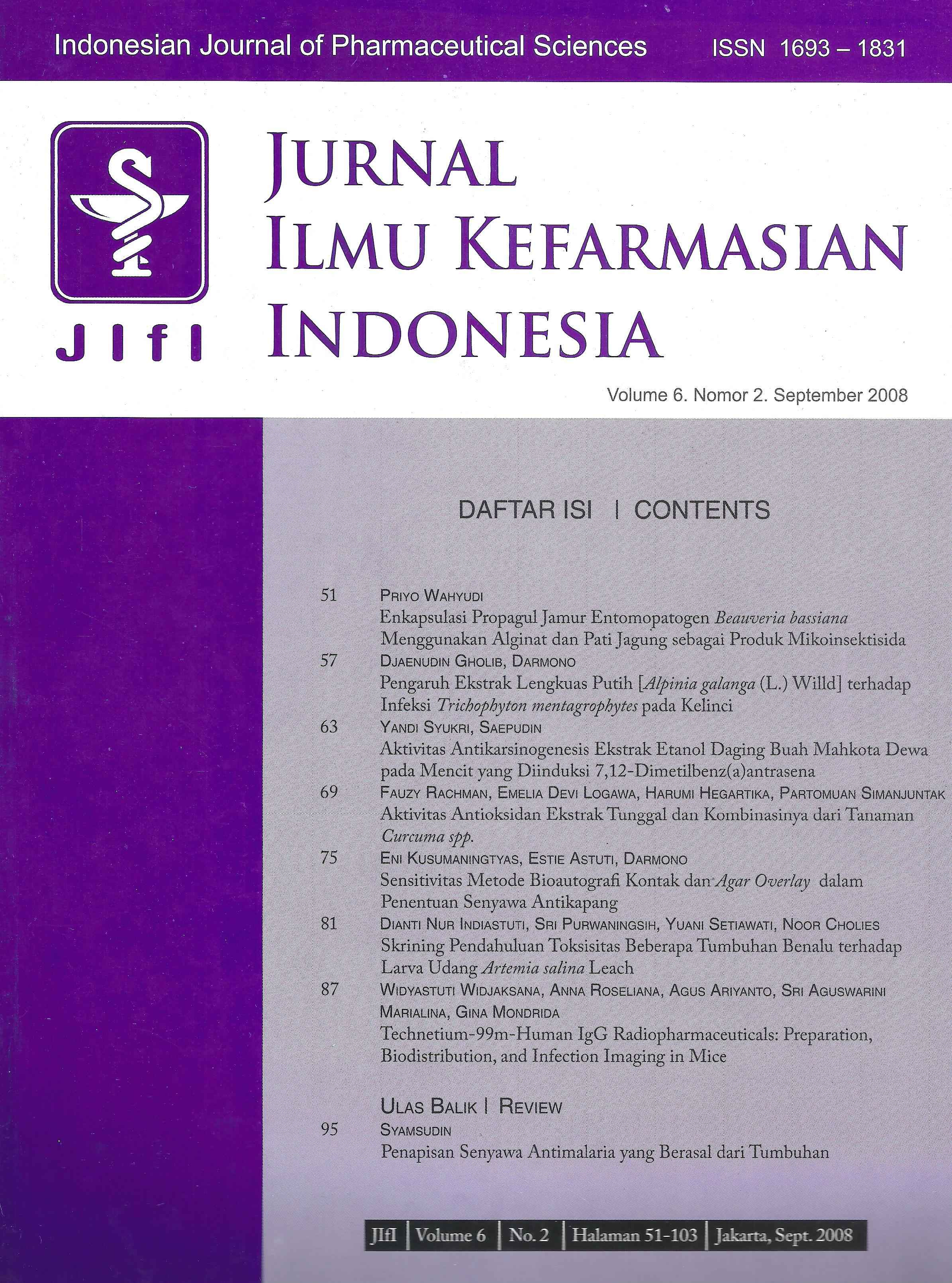
Penapisan Senyawa Antimalaria yang Berasal dari Tumbuhan
Keywords:
antimalarial drugs, screening models, in vitro, in vivoAbstract
Efforts to discover and develop new antimalarial drugs have increased dramatically in recent years mainly because of the parasites’ resistance to existing antimalarial drugs. Selection of drug candidates for clinical trials in man and the design of clinical protocols are based upon consideration of data from a battery of preclinical test systems. All compounds are assessed initially in one or more primary models. A compound which is considered active by well established criteria in primary screening test is considered for further evaluation in successively more rigorous clinical test. At the end of each stage of testing, a decision is taken to advance the compound to the next stage or to discontinue it. Primary screening tests should have optimal sensitivity, a high degree of reproducibility, high throughput, should require a minimum quantity of test compound and bear low cost. As there is growing need for newer and more efficacious antimalarial drugs escpecially in tropical countries, more sensitive and economical screening models are needed. This review is an update of various conventional and latest in vitro and in vivo screening methods being used for evaluation of antimalarial compounds.
References
Downloads
Published
Issue
Section
License
Licencing
All articles in Jurnal Ilmu Kefarmasian Indonesia are an open-access article, distributed under the terms of the Creative Commons Attribution-NonCommercial-ShareAlike 4.0 International License which permits unrestricted non-commercial used, distribution and reproduction in any medium.
This licence applies to Author(s) and Public Reader means that the users mays :
- SHARE:
copy and redistribute the article in any medium or format - ADAPT:
remix, transform, and build upon the article (eg.: to produce a new research work and, possibly, a new publication) - ALIKE:
If you remix, transform, or build upon the article, you must distribute your contributions under the same license as the original. - NO ADDITIONAL RESTRICTIONS:
You may not apply legal terms or technological measures that legally restrict others from doing anything the license permits.
It does however mean that when you use it you must:
- ATTRIBUTION: You must give appropriate credit to both the Author(s) and the journal, provide a link to the license, and indicate if changes were made. You may do so in any reasonable manner, but not in any way that suggests the licensor endorses you or your use.
You may not:
- NONCOMMERCIAL: You may not use the article for commercial purposes.

This work is licensed under a Creative Commons Attribution-NonCommercial-ShareAlike 4.0 International License.