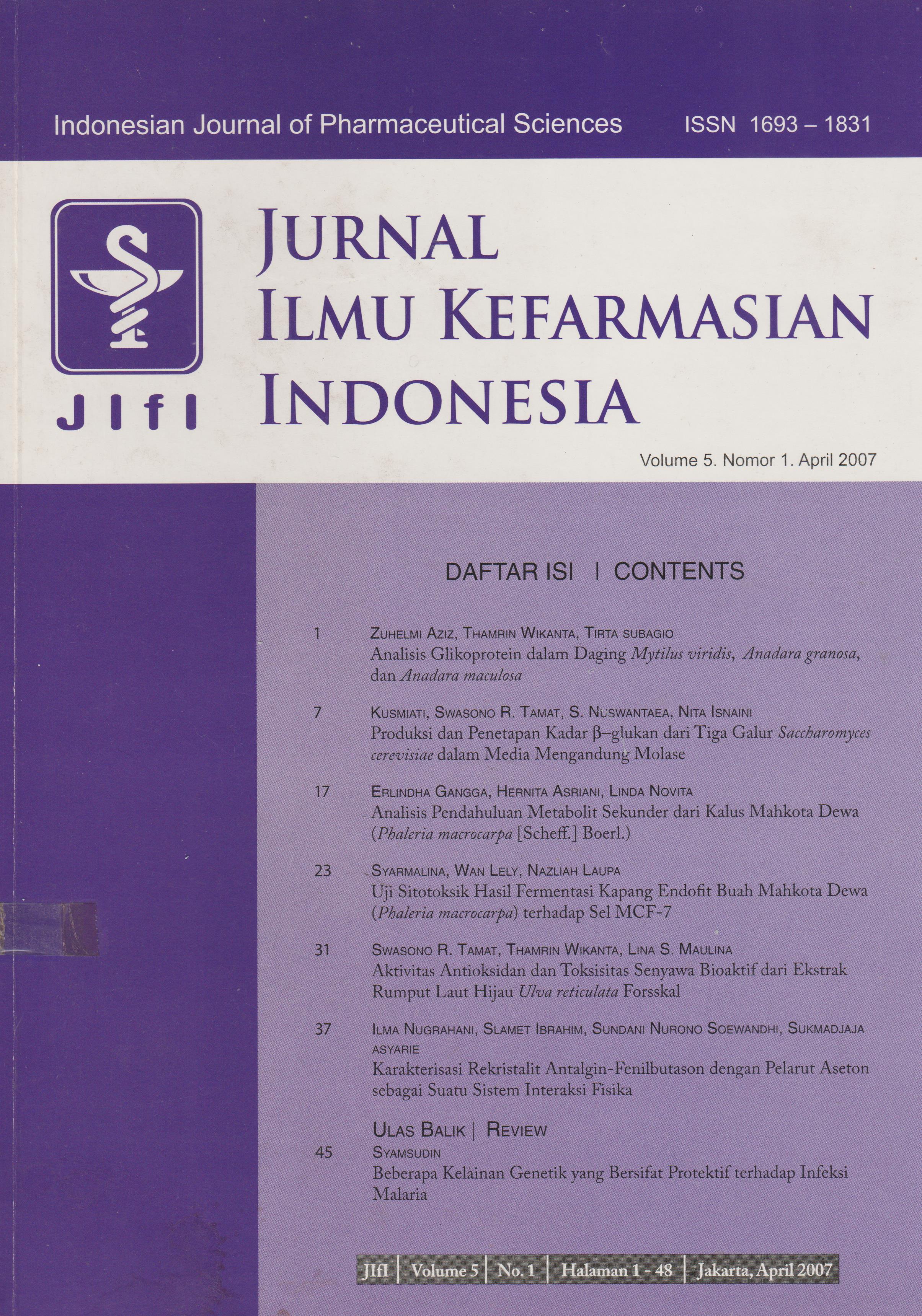
Uji Sitotoksik Hasil Fermentasi Kapang Endofit Buah Mahkota Dewa (Phaleria macrocarpa) terhadap Sel MCF-7
Keywords:
Cytotoxic test, fermentation, Phaleria macrocarpa, endophytic mould, MCF-7 cell, in vitroAbstract
In the development of traditional medicine, there are great demands of medicinal plant. Meanwhile, those demands exceed the capacity of natural resource to provide the raw material. The solution for that problem that has been developed is by utilizing organism that live on plant tissue, which known as endophytic microbe. The preliminary Brine Shrimp Lethality Test based research on the polarity degree of supernatant extracts has proved that it has high toxic activity on Artemia salina Leach. Subsequent to that study, a research to examine in vitro cytotoxic effect of supernatant extract fermented from Mahkota Dewa fruit endophytic mould KVM/a and KIVM/b isolate on breast cancer cell has been conducted. Thin layer chromatographic test was performed to identify the patch pattern from each fraction of KVM/a and KIVM/b isolate. Furthermore, preparative thin layer chromatographic test was tested on MCF-7 cell by using neutral red method. The cytotoxic effect was determined based on ICs, value. The results confirm the cytotoxic test effect of semi polar fraction of both isolates on MCF-7 cell with the ICs, value of 36.26 ppm for KVM/a and 30.48 ppm for KIVM/b.
References
Downloads
Published
Issue
Section
License
Licencing
All articles in Jurnal Ilmu Kefarmasian Indonesia are an open-access article, distributed under the terms of the Creative Commons Attribution-NonCommercial-ShareAlike 4.0 International License which permits unrestricted non-commercial used, distribution and reproduction in any medium.
This licence applies to Author(s) and Public Reader means that the users mays :
- SHARE:
copy and redistribute the article in any medium or format - ADAPT:
remix, transform, and build upon the article (eg.: to produce a new research work and, possibly, a new publication) - ALIKE:
If you remix, transform, or build upon the article, you must distribute your contributions under the same license as the original. - NO ADDITIONAL RESTRICTIONS:
You may not apply legal terms or technological measures that legally restrict others from doing anything the license permits.
It does however mean that when you use it you must:
- ATTRIBUTION: You must give appropriate credit to both the Author(s) and the journal, provide a link to the license, and indicate if changes were made. You may do so in any reasonable manner, but not in any way that suggests the licensor endorses you or your use.
You may not:
- NONCOMMERCIAL: You may not use the article for commercial purposes.

This work is licensed under a Creative Commons Attribution-NonCommercial-ShareAlike 4.0 International License.