
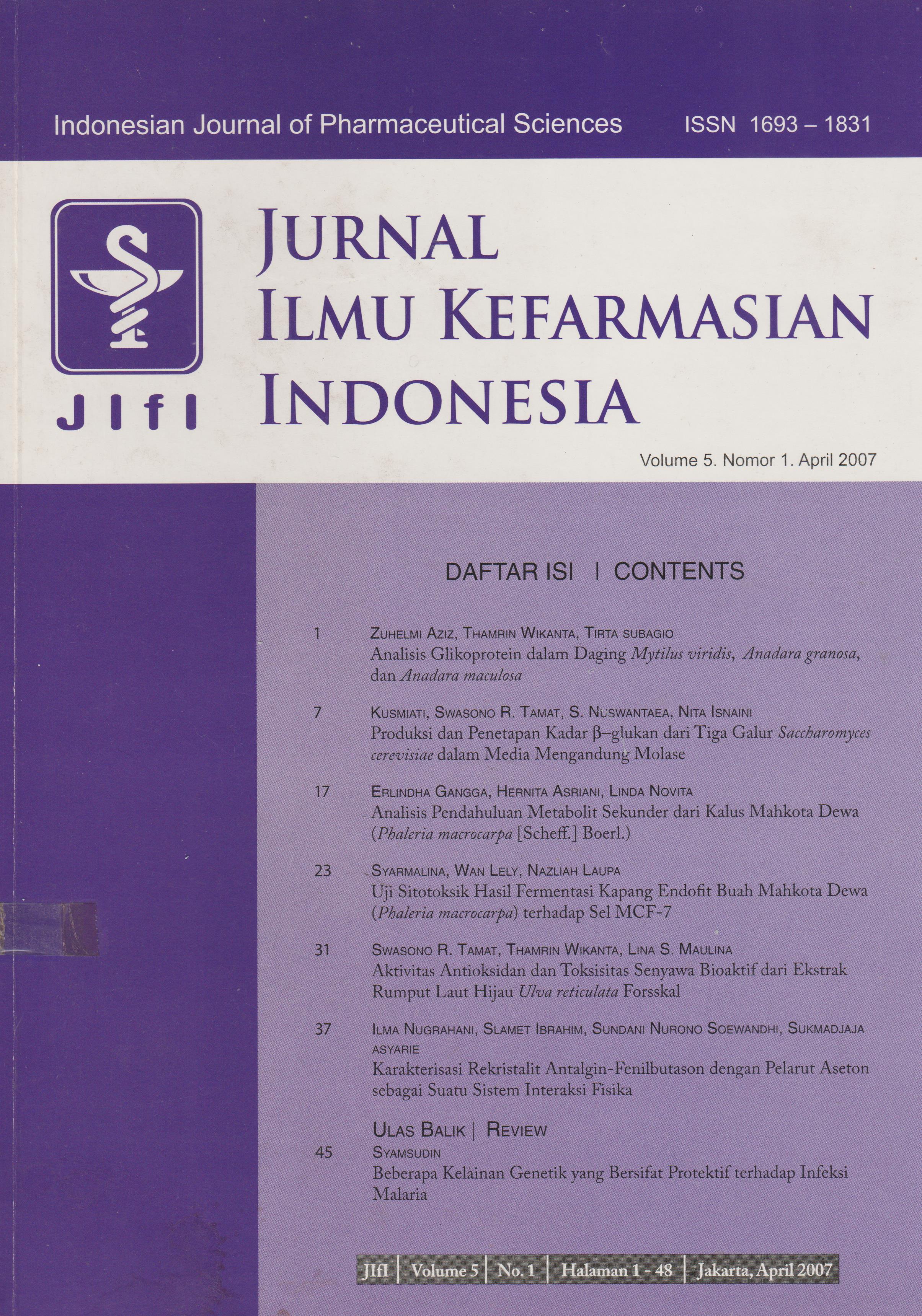
Aktivitas Antioksidan dan Toksisitas Senyawa Bioaktif dari Ekstrak Rumput Laut Hijau Ulva reticulata Forsskal
Keywords:
antioxidant, toxicity, BSLT, DPPH, Ulva reticulata ForsskalAbstract
Research on the antioxidative activity and toxicity of the bioactive substance of the green seaweed Ulva reticulata Forsskal extract had been carried out. The bioactive substance of the green seaweed Ulva reticulata Forsskal was extracted using methanol. The phytochemistry test on the methanol extract showed that the extract contained triterpenoid compound. The methanol extract was then partitioned using n-hexane-water (1:1) and chloroform-water (1:1). Each of the extract was then dried using freeze dryer. The antioxidative activity test of each fraction against free radical 1,1-diphenyl-2-picrilhydrazil (DPPH) showed that the water extract has the highest activity with IC 30 of 365,95 ug/ml. The toxicity test of each fraction against brine shrimp Artemia salina (Brine Shrimp Lethality Test, BSLT) showed that the chloroform extract showed the highest activity with LCs of 250,67 ug/ml. The water extract was then fractionated through silica column chromatography. The activity test of each fraction against DPPH and BSLT showed that fraction 1 has the highest activity with LCs of 100 ug/ml and ICs of 270,31ug/ ml. Identification using gas chromatography – mass spectrometric method showed that the antioxidative substance presence in the active fraction was probably nonyl phenol (C, H2,0).
References
Downloads
Issue
Section
License
Licencing
All articles in Jurnal Ilmu Kefarmasian Indonesia are an open-access article, distributed under the terms of the Creative Commons Attribution-NonCommercial-ShareAlike 4.0 International License which permits unrestricted non-commercial used, distribution and reproduction in any medium.
This licence applies to Author(s) and Public Reader means that the users mays :
- SHARE:
copy and redistribute the article in any medium or format - ADAPT:
remix, transform, and build upon the article (eg.: to produce a new research work and, possibly, a new publication) - ALIKE:
If you remix, transform, or build upon the article, you must distribute your contributions under the same license as the original. - NO ADDITIONAL RESTRICTIONS:
You may not apply legal terms or technological measures that legally restrict others from doing anything the license permits.
It does however mean that when you use it you must:
- ATTRIBUTION: You must give appropriate credit to both the Author(s) and the journal, provide a link to the license, and indicate if changes were made. You may do so in any reasonable manner, but not in any way that suggests the licensor endorses you or your use.
You may not:
- NONCOMMERCIAL: You may not use the article for commercial purposes.

This work is licensed under a Creative Commons Attribution-NonCommercial-ShareAlike 4.0 International License.













