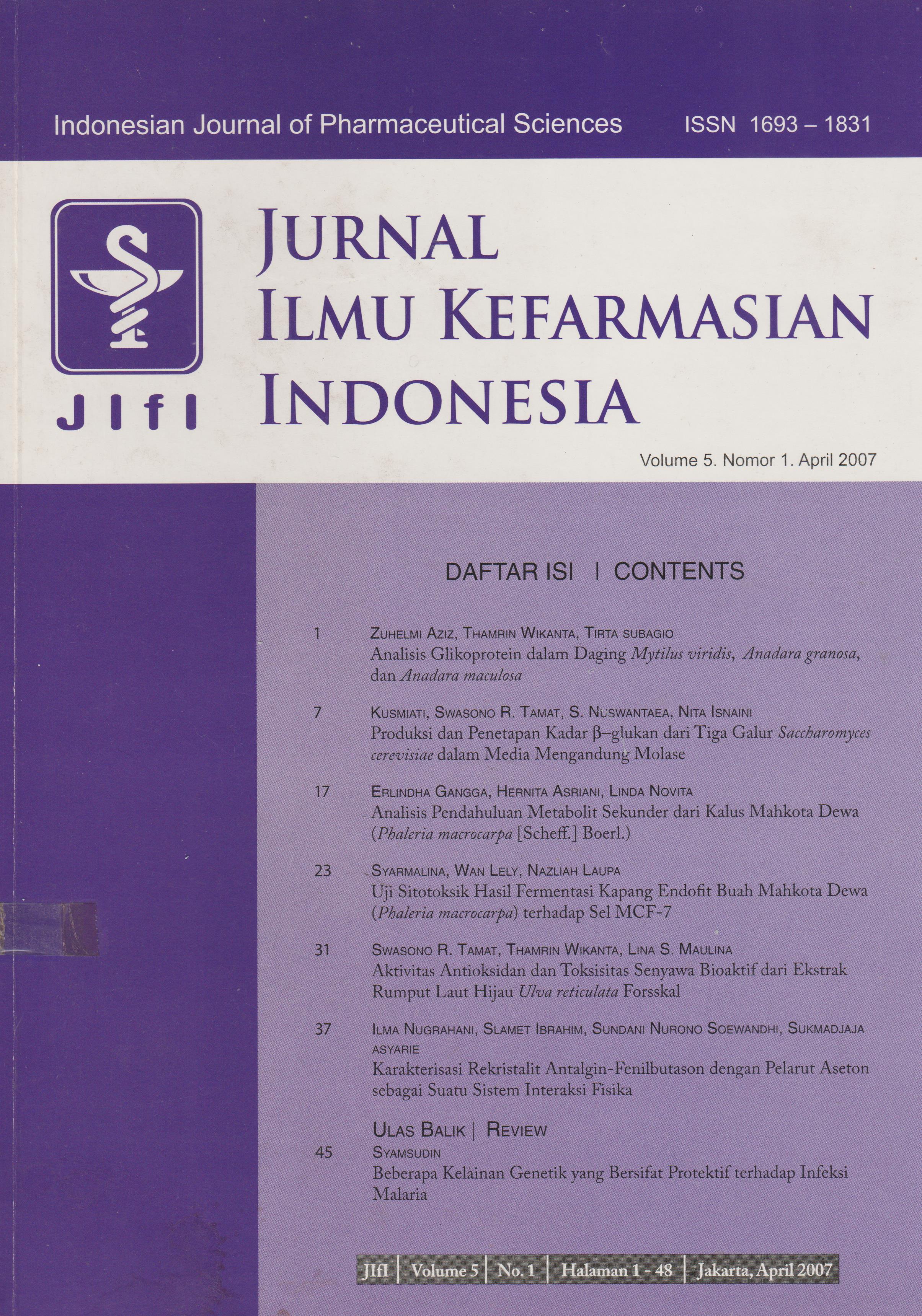
Karakterisasi Rekristalit Antalgin-Fenilbutason dengan Pelarut Aseton sebagai Suatu Sistem Interaksi Fisika
Keywords:
antalgyne, phenybutazone, recrystallization, acetone, polymorphism, solvatomorphims, peritecticumAbstract
Recrystallization with acetone of antalgyne, phenylbutazone, and the mixture of binary system has been characterized. The aim of this research was looking for thermodynamic and x-ray diffraction characteristic of re-crystallite to compare with raw material characteristics. The result used to confirm validity of cool contact methods to identify physical interaction of antalgine-phenylbutazone that has been developed in the preliminary research. Recrystallites characterized by DSC and powder-XRD shows the polymorphism cases, but the co-recrystallite of binary system show the peritecticum physical interaction, similar with the physical interaction of the raw material binary system before recrystallization. Principally, the results of this investigation prove that cool contact methods by acetone could be used for identify physical interaction of antalgine-phenylbutazone.
References
Downloads
Issue
Section
License
Licencing
All articles in Jurnal Ilmu Kefarmasian Indonesia are an open-access article, distributed under the terms of the Creative Commons Attribution-NonCommercial-ShareAlike 4.0 International License which permits unrestricted non-commercial used, distribution and reproduction in any medium.
This licence applies to Author(s) and Public Reader means that the users mays :
- SHARE:
copy and redistribute the article in any medium or format - ADAPT:
remix, transform, and build upon the article (eg.: to produce a new research work and, possibly, a new publication) - ALIKE:
If you remix, transform, or build upon the article, you must distribute your contributions under the same license as the original. - NO ADDITIONAL RESTRICTIONS:
You may not apply legal terms or technological measures that legally restrict others from doing anything the license permits.
It does however mean that when you use it you must:
- ATTRIBUTION: You must give appropriate credit to both the Author(s) and the journal, provide a link to the license, and indicate if changes were made. You may do so in any reasonable manner, but not in any way that suggests the licensor endorses you or your use.
You may not:
- NONCOMMERCIAL: You may not use the article for commercial purposes.

This work is licensed under a Creative Commons Attribution-NonCommercial-ShareAlike 4.0 International License.