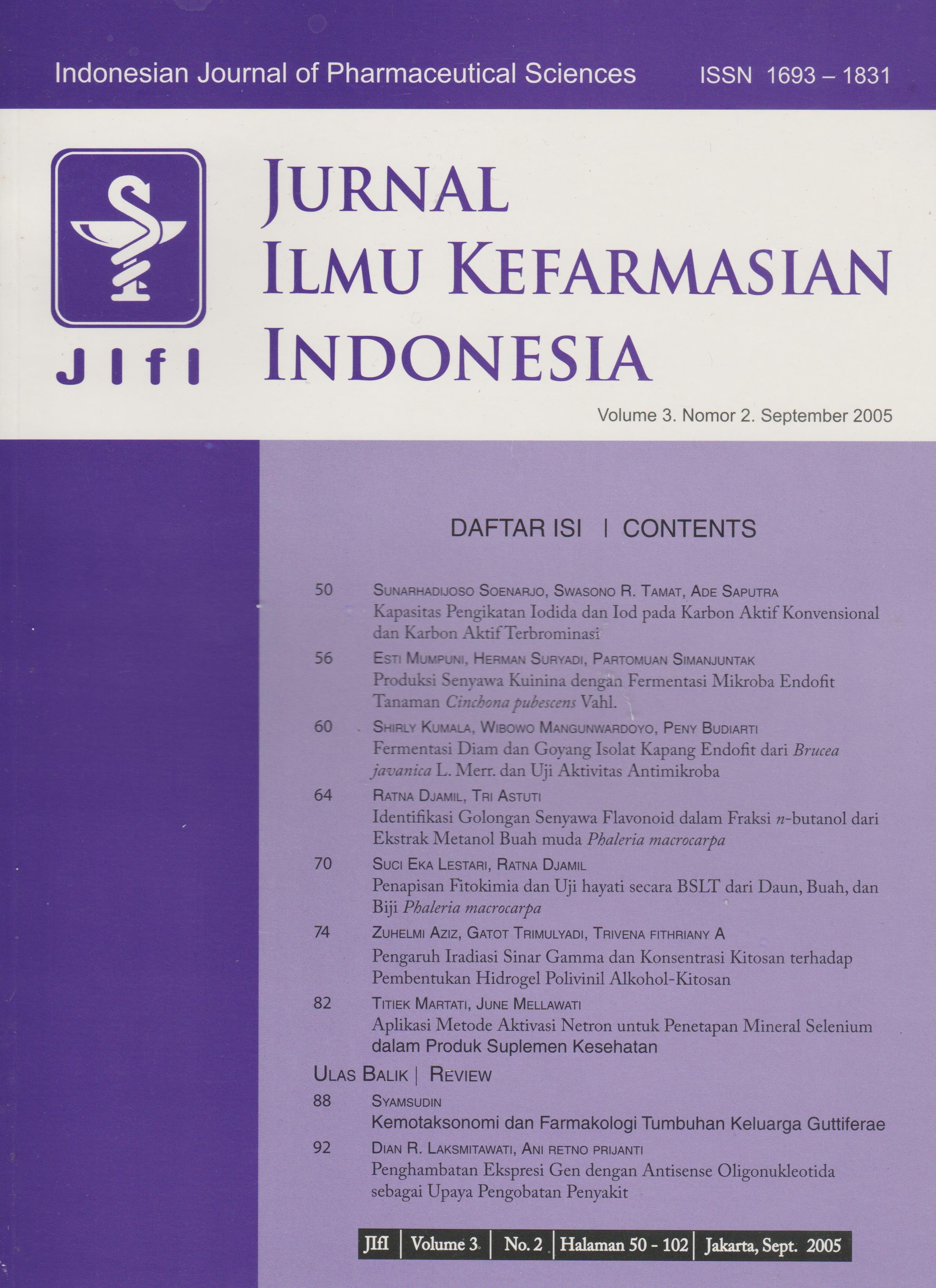
Kapasitas Pengikatan Iodida dan Iod pada Karbon Aktif Konvensional dan Terbrominasi
Keywords:
brominated active carbon, conventional active carbon, immobilizing agent, iodide, iodine, binding capacitiesAbstract
Related to the activities in a radioisotope processing laboratory at CDRR, BATAN, active carbon has a great potency and a role as adsorber for radioisotope immobilizing agent in process and installation systems. KAKEN Corporation, a CDRR's collaboration partner in Japan, has introduced a new type of active carbon namely KAKEN Brominated Active Carbon (KBAC) which is claimed to have an anionic exchange character. The presented experiment was thus performed to determine the iodide and iodine binding capacities of the KBAC resin as well as comparing to those of the conventional active carbon, which was also provided by KAKEN (KCAC). The experiment had been done using solutions of natural iodide and iodide - iodine mixtures. The binding capacities were determined by iodometry and iodatometry. In general the results obtained showed that the iodide-binding capacity of KBAC was higher than that of KCAC, but that the iodine-binding capacity of KCAC was higher. The KBAC showed that the binding capacity of iodide from iodide solutions was smaller than that from iodide-iodine samples, while the KCAC showed the reverse.
References
Downloads
Published
Issue
Section
License
Licencing
All articles in Jurnal Ilmu Kefarmasian Indonesia are an open-access article, distributed under the terms of the Creative Commons Attribution-NonCommercial-ShareAlike 4.0 International License which permits unrestricted non-commercial used, distribution and reproduction in any medium.
This licence applies to Author(s) and Public Reader means that the users mays :
- SHARE:
copy and redistribute the article in any medium or format - ADAPT:
remix, transform, and build upon the article (eg.: to produce a new research work and, possibly, a new publication) - ALIKE:
If you remix, transform, or build upon the article, you must distribute your contributions under the same license as the original. - NO ADDITIONAL RESTRICTIONS:
You may not apply legal terms or technological measures that legally restrict others from doing anything the license permits.
It does however mean that when you use it you must:
- ATTRIBUTION: You must give appropriate credit to both the Author(s) and the journal, provide a link to the license, and indicate if changes were made. You may do so in any reasonable manner, but not in any way that suggests the licensor endorses you or your use.
You may not:
- NONCOMMERCIAL: You may not use the article for commercial purposes.

This work is licensed under a Creative Commons Attribution-NonCommercial-ShareAlike 4.0 International License.