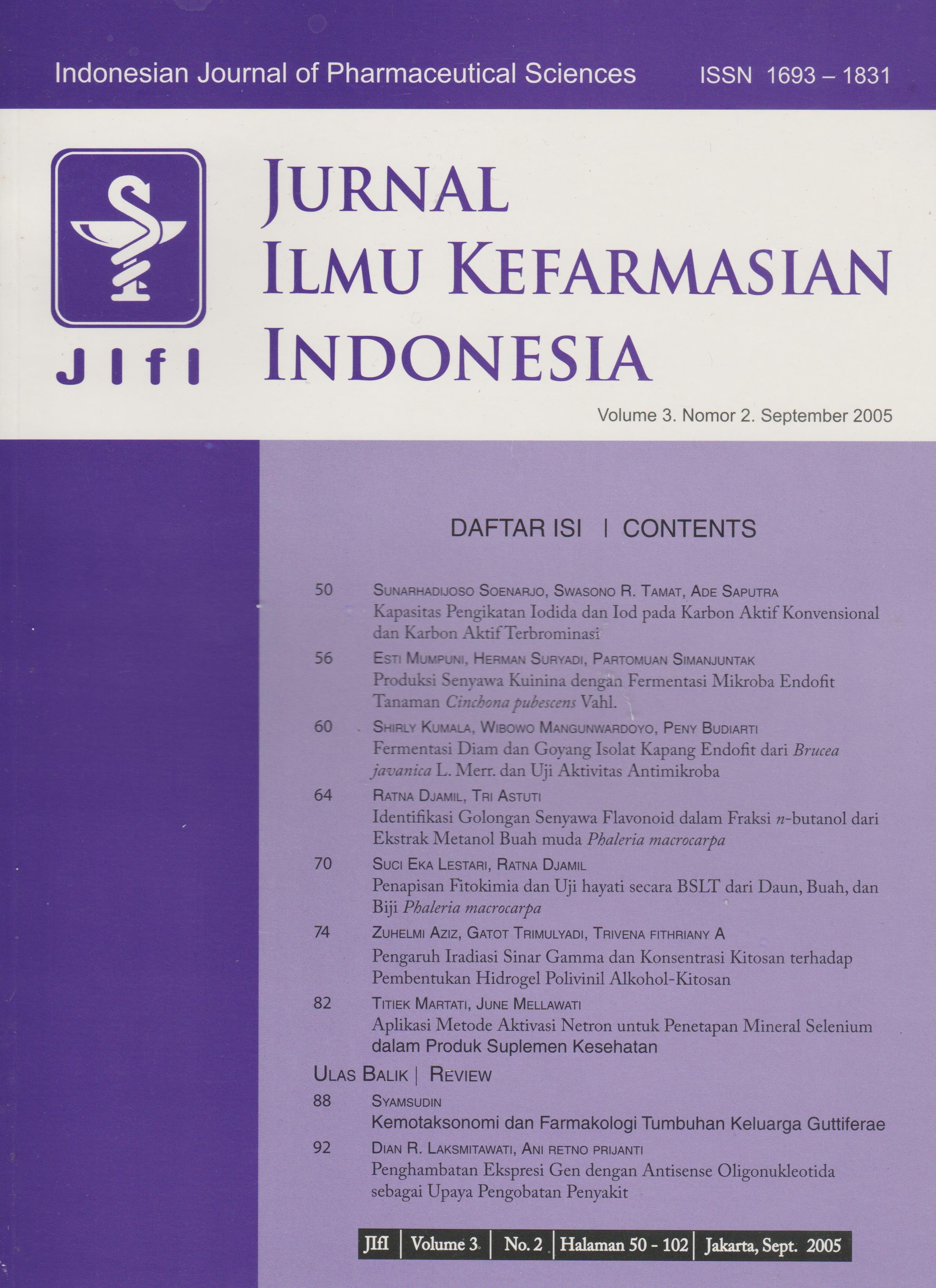
Pengaruh Iradiasi Sinar Gamma dan Konsentrasi Kitosan terhadap Pembentukan Hidrogel Polivinil Alkohol-Kitosan
Keywords:
chitosan, polyvinil alcohol (PVA), iradiation, hydrogelAbstract
Chitosan is one of the product from the shrimp disposal. Its medicinal and pharmaceutics application are now developed by pharmaceutical industries, i.e as bioplastics and hydrogel. A research about the effect of gamma radiation and chitosan as a raw material for production of polyvinilalcohol has been carried out. PVA-chitosan hydrogel was made from a mixture of composition of 80% PVA in 10% solution and 20% of chitosan in 0, 1, 2 ,and 3% solution respectively. The mixture was heated in oven at 80°C for two hours and then irradiated with 0, 15, 25, and 35 kGy gamma radiation. The physical characteristic of the gel was determined, e.g. colour, swelling degree and gel fraction. The colour of hydrogel more yellow darker to raising of chitosan concentration and radiation dosage. Swelling degree PVA-chitosan hydrogel increased meanwhile chitosan concentration and radiation dosage decreased. In absolute ethanol medium (96%) PVA-chitosan hydrogel was deswelling. The swelling degree PVAchitosan hydrogel decreased with increased gel fraction.
References
Downloads
Issue
Section
License
Licencing
All articles in Jurnal Ilmu Kefarmasian Indonesia are an open-access article, distributed under the terms of the Creative Commons Attribution-NonCommercial-ShareAlike 4.0 International License which permits unrestricted non-commercial used, distribution and reproduction in any medium.
This licence applies to Author(s) and Public Reader means that the users mays :
- SHARE:
copy and redistribute the article in any medium or format - ADAPT:
remix, transform, and build upon the article (eg.: to produce a new research work and, possibly, a new publication) - ALIKE:
If you remix, transform, or build upon the article, you must distribute your contributions under the same license as the original. - NO ADDITIONAL RESTRICTIONS:
You may not apply legal terms or technological measures that legally restrict others from doing anything the license permits.
It does however mean that when you use it you must:
- ATTRIBUTION: You must give appropriate credit to both the Author(s) and the journal, provide a link to the license, and indicate if changes were made. You may do so in any reasonable manner, but not in any way that suggests the licensor endorses you or your use.
You may not:
- NONCOMMERCIAL: You may not use the article for commercial purposes.

This work is licensed under a Creative Commons Attribution-NonCommercial-ShareAlike 4.0 International License.