
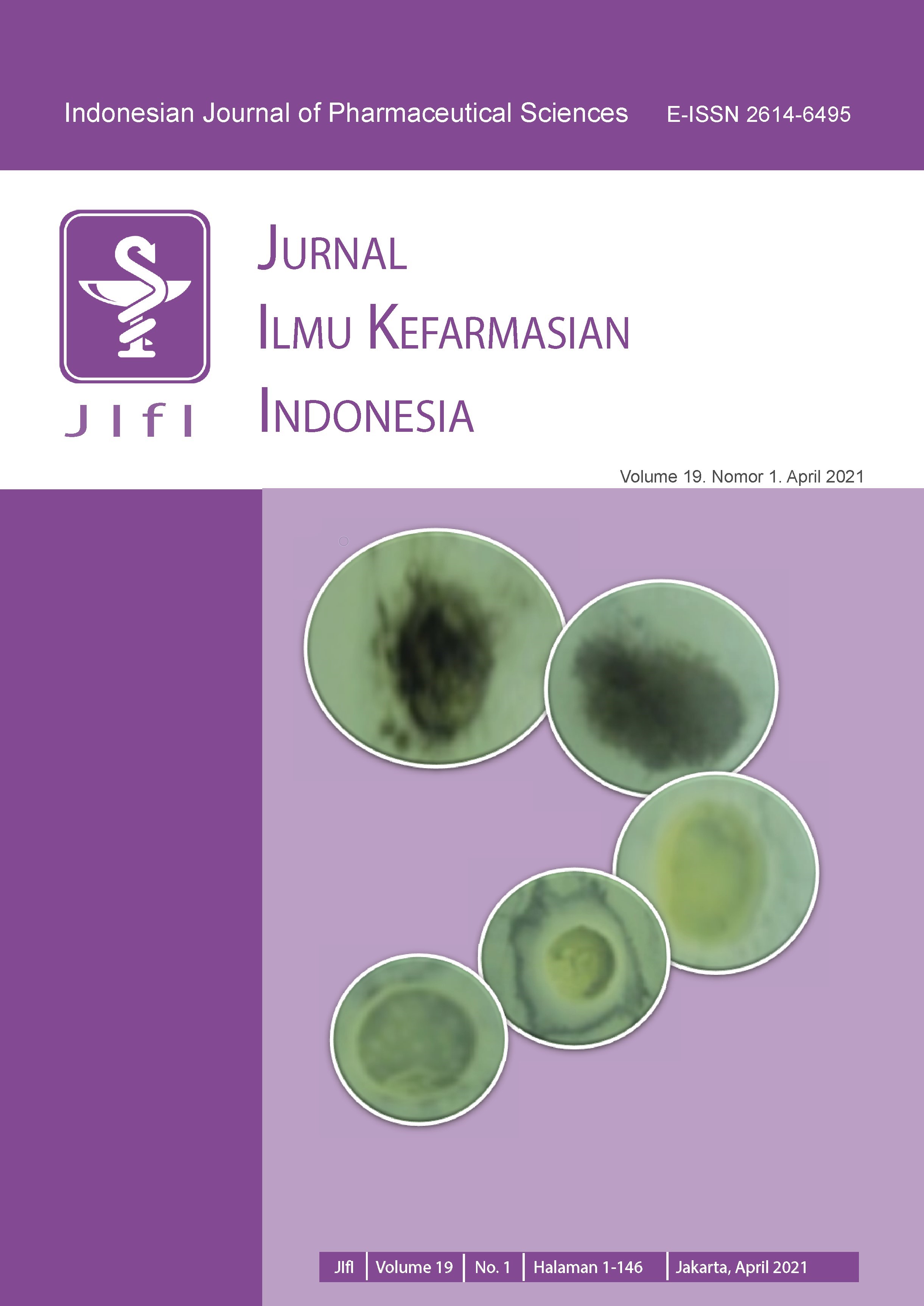
Extracellular Products of Endophytic Fungi Isolate C.1.1 and C.3.3 from Cempaka Kuning Branch (Michelia champaca L.) as an Antimicrobial
DOI:
https://doi.org/10.35814/jifi.v19i1.985Keywords:
Endophytic Fungi, Microbial Activities, Secondary Metabolites, Branch of (Michelia champaca L.)Abstract
Michelia champaca L. is known to have effi cacy as an antimicrobial, antioxidant, and anticancer.
In general, endophytic fungi that live in plant tissues is capable of producing secondary metabolites as their
host plant. The objective of this research is to examine the antimicrobial potential of endophytic mold isolates C.1.1 and C.3.3 from yellow cempaka branches (Michelia champaca L.). Isolates obtained from previous research, fi rst was rejuvenated on PDA. Fermentation was carried out on each isolate for 12 days. The fermented supernatant was then extracted partially with n-hexane, ethyl acetate, and n-butanol solvent. The extract was then concentrated and tested for antimicrobial activity using disk diff usion and microdilution methods. N-butanol extract of endophytic fungi isolates of yellow champaca branches was able to inhibit the microbial growth with the largest inhibition area in isolate C.1.1 in Staphylococcus aureus ATCC 6538 (12.26 mm), Escherichia coli ATCC 8739 (11.40 mm), Candida albicans ATCC 10231 (10.50 mm), and Metichillin-Resistant Staphylococcus aureus (11.30 mm) with Minimum Inhibitory Concentration and Minimum Concentration of 12,5% . It was concluded that both endophytic fungi isolates of yellow champaca branches had the potential to inhibit the growth of pathogenic microbes.
References
Downloads
Published
Issue
Section
License
Licencing
All articles in Jurnal Ilmu Kefarmasian Indonesia are an open-access article, distributed under the terms of the Creative Commons Attribution-NonCommercial-ShareAlike 4.0 International License which permits unrestricted non-commercial used, distribution and reproduction in any medium.
This licence applies to Author(s) and Public Reader means that the users mays :
- SHARE:
copy and redistribute the article in any medium or format - ADAPT:
remix, transform, and build upon the article (eg.: to produce a new research work and, possibly, a new publication) - ALIKE:
If you remix, transform, or build upon the article, you must distribute your contributions under the same license as the original. - NO ADDITIONAL RESTRICTIONS:
You may not apply legal terms or technological measures that legally restrict others from doing anything the license permits.
It does however mean that when you use it you must:
- ATTRIBUTION: You must give appropriate credit to both the Author(s) and the journal, provide a link to the license, and indicate if changes were made. You may do so in any reasonable manner, but not in any way that suggests the licensor endorses you or your use.
You may not:
- NONCOMMERCIAL: You may not use the article for commercial purposes.

This work is licensed under a Creative Commons Attribution-NonCommercial-ShareAlike 4.0 International License.













