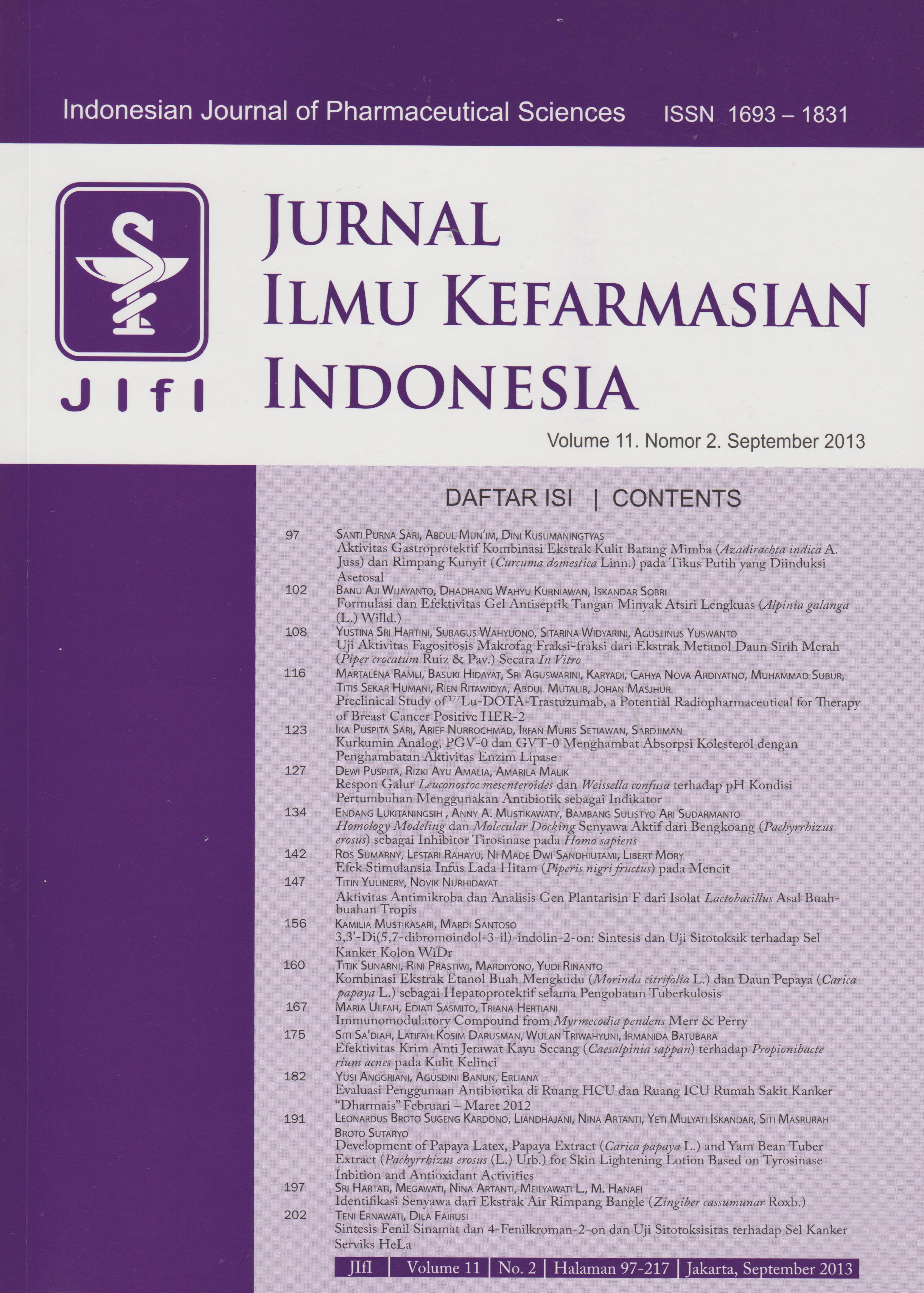
Homology Modeling dan Molecular Docking Senyawa Aktif dari Bengkoang (Pachyrrhizus erosus) sebagai Inhibitor Tirosinase pada Homo sapiens
Kata Kunci:
tirosinase, homology modeling, bengkoang (Pachyrrhizus erosus), molecular dockingAbstrak
Salah satu mekanisme obat pemutih adalah dengan menghambat kerja enzim tirosinase pada proses melanogenesis. Namun, enzim tirosinase manusia belum dapat dideterminasikan secara eksperimental, sehingga penelitian terhadap tirosinase manusia belum dapat dilakukan. Homology modeling merupakan salah satu cara yang dapat digunakan untuk memodelkan struktur tiga dimensi dari enzim tirosinase pada manusia. Dari model tersebut diprediksi interaksi senyawa dalam bengkoang (Pachyrrhizus erosus) dalam menghambat enzim tirosinase pada manusia menggunakan pendekatan molecular docking yaitu dengan analisis pose. Di samping itu juga dapat diprediksi kekuatan ikatan antara senyawa ligan pada binding site protein target dengan menganalisis skor yang dihasilkan. Homology modeling dikerjakan dengan menggunakan template Bacillus megaterium (TyrBm) dan metode Amber99 dari piranti lunak MOE 2009.10. Model yang didapatkan dievaluasi menggunakan analisis Ramachandran plot, z-score, dan plot energi ProSA. Model terbaik digunakan untuk molecular docking menggunakan active site ligand, placement method ALPHA PMI, dan scoring affinity DG dari piranti lunak MOE 2009.10. Model terbaik adalah TyrHSM (alignment default MOE) dengan 96,7% residu berada di allowed region pada Ramachandran Plot, memiliki positive region paling sedikit, dan memiliki ratio z-score >1. Senyawa ligan bengkoang yang diprediksi memiliki afinitas paling baik pada tirosinase manusia adalah 2-butoksi-2,5-bis(hidroksimetil)-tetrahidrofuran-3,4-diol dengan skor -0,3598 kkal/mol.
Referensi
Unduhan
Diterbitkan
Terbitan
Bagian
Lisensi
Licencing
All articles in Jurnal Ilmu Kefarmasian Indonesia are an open-access article, distributed under the terms of the Creative Commons Attribution-NonCommercial-ShareAlike 4.0 International License which permits unrestricted non-commercial used, distribution and reproduction in any medium.
This licence applies to Author(s) and Public Reader means that the users mays :
- SHARE:
copy and redistribute the article in any medium or format - ADAPT:
remix, transform, and build upon the article (eg.: to produce a new research work and, possibly, a new publication) - ALIKE:
If you remix, transform, or build upon the article, you must distribute your contributions under the same license as the original. - NO ADDITIONAL RESTRICTIONS:
You may not apply legal terms or technological measures that legally restrict others from doing anything the license permits.
It does however mean that when you use it you must:
- ATTRIBUTION: You must give appropriate credit to both the Author(s) and the journal, provide a link to the license, and indicate if changes were made. You may do so in any reasonable manner, but not in any way that suggests the licensor endorses you or your use.
You may not:
- NONCOMMERCIAL: You may not use the article for commercial purposes.

This work is licensed under a Creative Commons Attribution-NonCommercial-ShareAlike 4.0 International License.