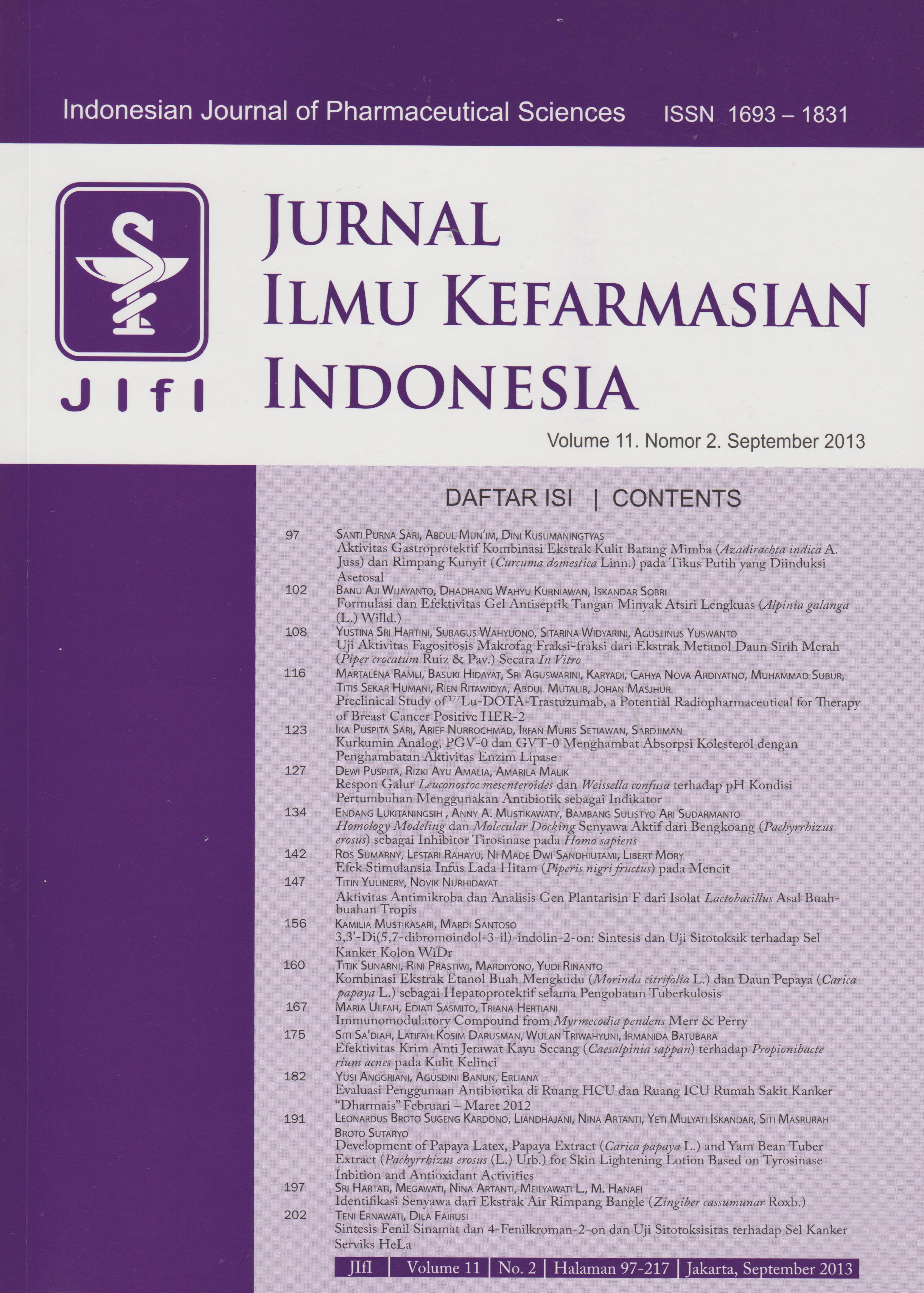
Aktivitas Antimikroba dan Analisis Gen Plantarisin F dari Isolat Lactobacillus Asal Buah-buahan Tropis
Kata Kunci:
plantarisin F, antimikroba, Lactobacillus, probiotik, buah-buahan tropisAbstrak
Lactobacillus yang berasal dari buah-buahan tropis dapat digunakan sebagai probiotik dan berpotensi mencegah penyakit pada saluran pencernaan karena menghasilkan bakteriosin. Salah satu bakteriosin adalah plantarisin F yang dihasilkan oleh Lactobacillus plantarum. Plantarisin F mempunyai aktivitas antimikroba terhadap bakteri Gram positif maupun Gram negatif. Penelitian ini bertujuan untuk menguji aktivitas antibakteri beberapa isolat Lactobacillus terhadap 5 bakteri uji dan menganalisa ekspresi gen plantarisin F. Dari sepuluh isolat Lactobacillus terpilih, tujuh isolat mampu menghambat bakteri Gram positif dan Gram negatif. Isolat TB (NK) memiliki daya hambat paling besar terhadap E. coli yakni 2,05 cm, dan dua kali lebih kuat dibandingkan kontrol kloramfenikol. Sebagai konfirmasi dilakukan analisis gen plantarisin F dengan RT-PCR. Hasil pengujian RT-PCR menunjukkan bahwa ukuran gen plantarisin F adalah ± 70 bp. Nilai ekspresi relatif gen plantarisin F paling tinggi ditunjukkan oleh isolat Mar A2 dengan nilai 10,676 Au, diikuti oleh isolat TB (NK) dengan nilai 2,9207 Au, sedangkan isolat TB (CK) memiliki nilai ekspresi relatif gen plantarisin F paling rendah yaitu sebesar 0,5141 Au. Isolat Lactobacillus TB (NK) dapat dijadikan kandidat probiotik dan antibiotik alternatif untuk mencegah penyakit saluran pencernaan
Referensi
Unduhan
Diterbitkan
Terbitan
Bagian
Lisensi
Licencing
All articles in Jurnal Ilmu Kefarmasian Indonesia are an open-access article, distributed under the terms of the Creative Commons Attribution-NonCommercial-ShareAlike 4.0 International License which permits unrestricted non-commercial used, distribution and reproduction in any medium.
This licence applies to Author(s) and Public Reader means that the users mays :
- SHARE:
copy and redistribute the article in any medium or format - ADAPT:
remix, transform, and build upon the article (eg.: to produce a new research work and, possibly, a new publication) - ALIKE:
If you remix, transform, or build upon the article, you must distribute your contributions under the same license as the original. - NO ADDITIONAL RESTRICTIONS:
You may not apply legal terms or technological measures that legally restrict others from doing anything the license permits.
It does however mean that when you use it you must:
- ATTRIBUTION: You must give appropriate credit to both the Author(s) and the journal, provide a link to the license, and indicate if changes were made. You may do so in any reasonable manner, but not in any way that suggests the licensor endorses you or your use.
You may not:
- NONCOMMERCIAL: You may not use the article for commercial purposes.

This work is licensed under a Creative Commons Attribution-NonCommercial-ShareAlike 4.0 International License.