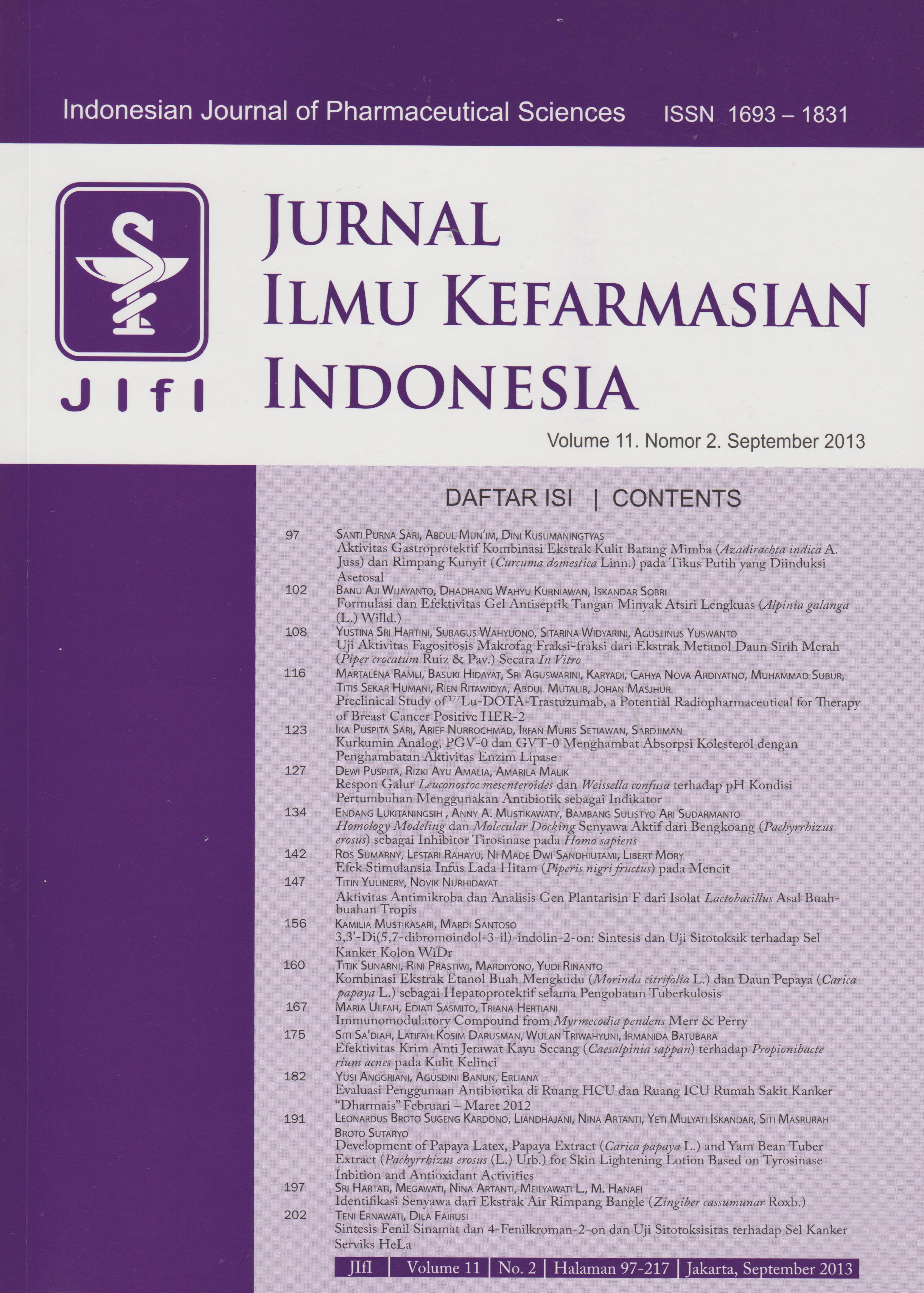
Sintesis Fenil Sinamat dan 4-Fenilkroman-2-on dan Uji Sitotoksisitas Terhadap Sel Kanker Serviks HeLa
Kata Kunci:
fenil sinamat, 4-fenilkroman-2-on, BSLT, sitotoksisitas, MTT, sel HeLaAbstrak
Asam sinamat merupakan turunan dari metil sinamat, yang termasuk dalam jalur turunan asam shikimat. Asam sinamat dan analog alaminya dikenal dalam pengobatan kanker selama beberapa abad. Sintesis fenil sinamat dan 4-fenilkroman-2-on telah dilakukan dari metil sinamat dengan menggunakan katalis asam. Senyawa metil sinamat terlebih dahulu dikonversi menjadi asam sinamat melalui reaksi hidrolisis dengan basa. Selanjutnya asam sinamat diklorinasi menggunakan tionil klorida dan fenol dan menghasilkan fenil sinamat. Reaksi esterifikasi dengan fenol menggunakan katalis asam p-toluen sulfonat menghasilkan senyawa 4-fenilkroman-2-on. Dari peneitian ini diperoleh rendemen hasil sintesis asam sinamat, fenil sinamat dan 4-fenilkroman-2-on masing-masing adalah 83,6%, 14,71% dan 16,18%. Uji sitotoksisitas senyawa fenil sinamat dan 4-fenilkroman-2-on menggunakan metode brine shrimp lethality test (BSLT) diperoleh nilai LC50 masing-masing sebesar 223,87 dan 112,72 ppm. Hasil uji fenil sinamat dan 4-fenilkroman-2-on terhadap sel kanker serviks HeLa (ATCC CCL2) dengan metode MTT didapatkan persentase inhibisi masing-masing adalah di atas 50%.
Referensi
Unduhan
Diterbitkan
Terbitan
Bagian
Lisensi
Licencing
All articles in Jurnal Ilmu Kefarmasian Indonesia are an open-access article, distributed under the terms of the Creative Commons Attribution-NonCommercial-ShareAlike 4.0 International License which permits unrestricted non-commercial used, distribution and reproduction in any medium.
This licence applies to Author(s) and Public Reader means that the users mays :
- SHARE:
copy and redistribute the article in any medium or format - ADAPT:
remix, transform, and build upon the article (eg.: to produce a new research work and, possibly, a new publication) - ALIKE:
If you remix, transform, or build upon the article, you must distribute your contributions under the same license as the original. - NO ADDITIONAL RESTRICTIONS:
You may not apply legal terms or technological measures that legally restrict others from doing anything the license permits.
It does however mean that when you use it you must:
- ATTRIBUTION: You must give appropriate credit to both the Author(s) and the journal, provide a link to the license, and indicate if changes were made. You may do so in any reasonable manner, but not in any way that suggests the licensor endorses you or your use.
You may not:
- NONCOMMERCIAL: You may not use the article for commercial purposes.

This work is licensed under a Creative Commons Attribution-NonCommercial-ShareAlike 4.0 International License.