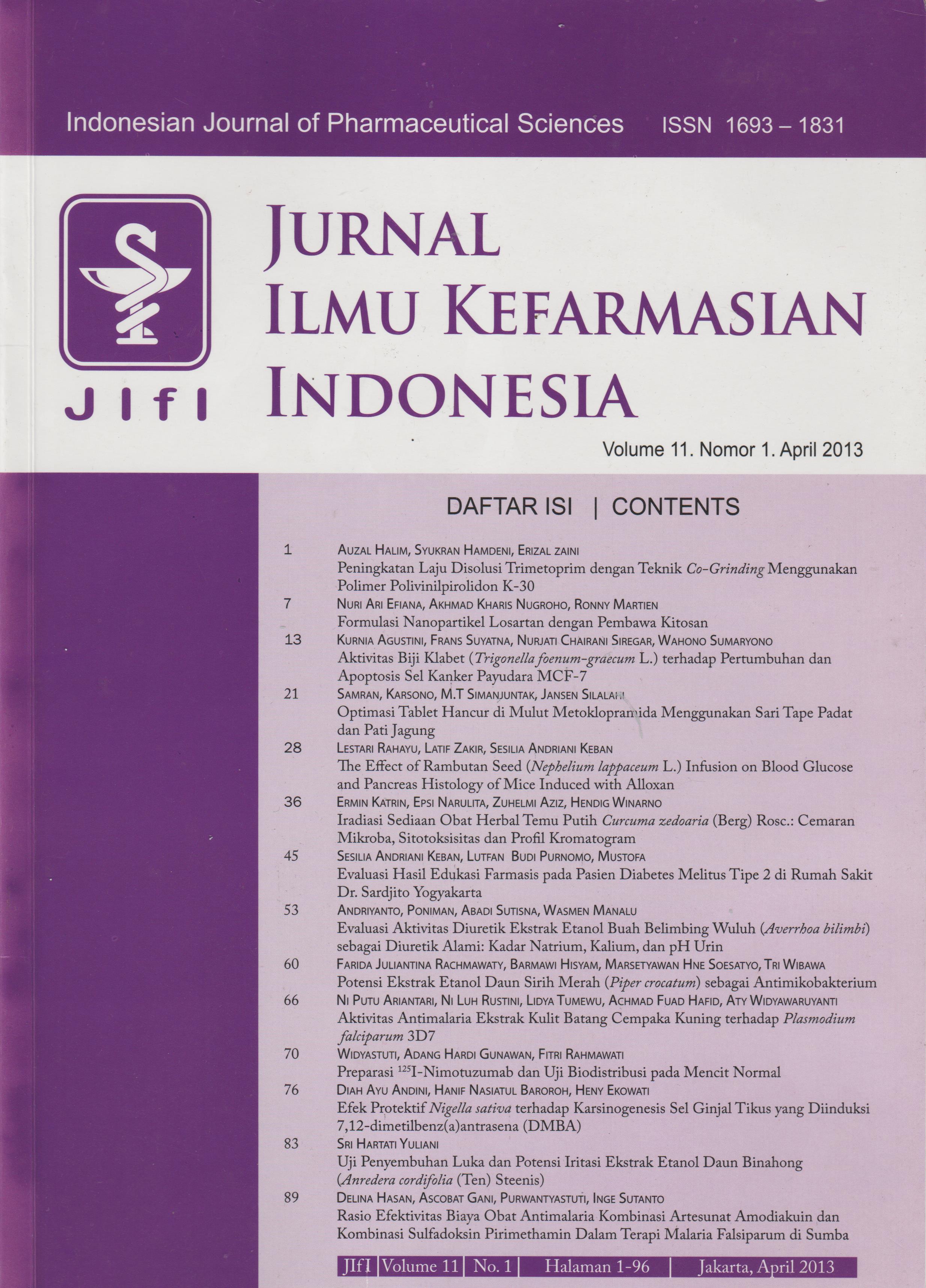
Formulasi Nanopartikel Losartan dengan Pembawa Kitosan
Kata Kunci:
losartan, kitosan, nanopartikel, desain faktorialAbstrak
Nanopartikel semakin banyak dikembangkan untuk meningkatkan transpor sistemik obat pada berbagai rute penghantaran. Penelitian ini bertujuan untuk memperoleh kondisi optimal pada pembentukan nanopartikel kitosan dengan losartan, suatu senyawa antagonis reseptor angiotensin II yang digunakan sebagai anti hipertensi. Metode yang digunakan adalah ionic gelation. Formulasi dilakukan dalam 2 tahap. Pertama, penentuan konsentrasi losartan dan kitosan terbaik yang dapat membentuk nanopartikel yang stabil secara fisik (tidak terjadi pengendapan), yang ditunjukkan dengan uji penyimpanan pada suhu kamar selama 25 hari. Kedua, optimasi formula dengan metode desain faktorial dengan dua variabel yaitu pH (4,0 dan 5,0) dan kecepatan pengadukan (350 dan 700 rpm), dengan respon yang diamati yaitu loading capacity. Nanopartikel yang terbentuk dievaluasi ukuran partikel dan zeta potensialnya. Hasil uji stabilitas fisik nanopartikel menunjukkan formula dengan kadar losartan-kitosan (14 mg% : 35 mg%) serta losartan-kitosan (21 mg% : 35 mg%) mempunyai stabilitas yang baik. Hasil uji optimasi proses menunjukkan bahwa pH 4,0 dan kecepatan pengadukan 350 rpm merupakan kondisi optimal yang menghasilkan loading capacity terbesar (47,7%). Nanopartikel yang stabil mempunyai ukuran 290,3±52,6 nm dengan zeta potensial +50,8±4,8 mV.
Referensi
Unduhan
Diterbitkan
Terbitan
Bagian
Lisensi
Licencing
All articles in Jurnal Ilmu Kefarmasian Indonesia are an open-access article, distributed under the terms of the Creative Commons Attribution-NonCommercial-ShareAlike 4.0 International License which permits unrestricted non-commercial used, distribution and reproduction in any medium.
This licence applies to Author(s) and Public Reader means that the users mays :
- SHARE:
copy and redistribute the article in any medium or format - ADAPT:
remix, transform, and build upon the article (eg.: to produce a new research work and, possibly, a new publication) - ALIKE:
If you remix, transform, or build upon the article, you must distribute your contributions under the same license as the original. - NO ADDITIONAL RESTRICTIONS:
You may not apply legal terms or technological measures that legally restrict others from doing anything the license permits.
It does however mean that when you use it you must:
- ATTRIBUTION: You must give appropriate credit to both the Author(s) and the journal, provide a link to the license, and indicate if changes were made. You may do so in any reasonable manner, but not in any way that suggests the licensor endorses you or your use.
You may not:
- NONCOMMERCIAL: You may not use the article for commercial purposes.

This work is licensed under a Creative Commons Attribution-NonCommercial-ShareAlike 4.0 International License.