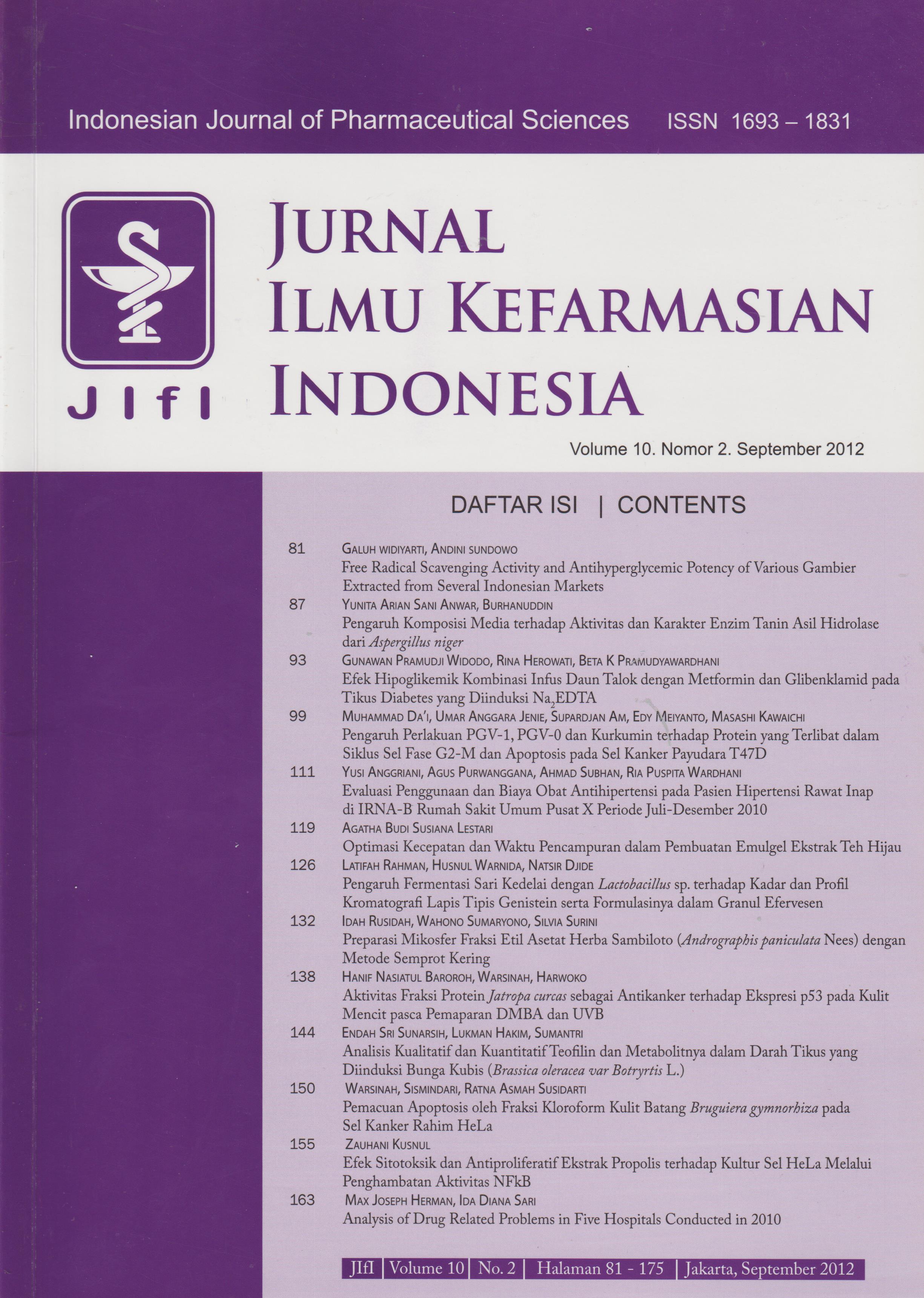
Pengaruh Fermentasi Sari Kedelai dengan Lactobacillus sp. terhadap Kadar dan Profil Kromatografi Lapis Tipis Genistein serta Formulasinya dalam Granul Efervesen
Kata Kunci:
Sari kedelai, fermentasi, genistein, profil KLT, granul efervesen, Lactobacillus sp.Abstrak
Isoflavon dalam kedelai dan hasil olahan kedelai tanpa fermentasi berbentuk glikosida. Bentuk glikosida tidak dapat diabsorpsi oleh tubuh dan harus dihidrolisis sebelum dimetabolisme. Hidrolisis oleh bakteri penghasil β-glucosidase terjadi di sepanjang saluran cema. Mikroorganisme probiotik, misal Lactobacillus dan Bijidobacterium memiliki enzim , β-glucosidase endogen yang berperan penting dalam mengubah profil isoilavon selama fermentasi. Oleh karena itu, penelitian ini bertujuan untuk mengetahui pengaruh fermentasi sari kedelai dengan Lactobacillus sp. pada proiil KLT dan kadar genistein dan formulasi sari kedelai menjadi sediaan granul efervesen. Sari kedelai difermentasi dengan Lactobaccillus sp. dan dikeringkan dengan metode freeze-drying. Sari kedelai kering diekstraksi dengan metanol dan dianalisis dengan TLC-scanner. Serbuk sari kedelai terfermentasi kering kemudian diformulasi dalam bentuk sediaan granul efervesen dengan variasi konsentrasi asam sitrat-asam tartrat. Granul efervesen dibuat dengan metode granulasi basah kemudian dievaluasi karateristik fisik dan dianalisis dengan TLC-scanner. Kadar Genistein dalam sari kedelai yang telah diferrnentasi mengalami peningkatan 145,32% dibandingkan sari kedelai sebelum difermentasi. Keempat formula granul efervesen yang dibuat mempunyai karateristik fisik yang baik, kecuali kandungan kelembaban lebih dari 0,7%. Formula dengan perbandingan konsentrasi asam sitrat-asam tartrat (1:1) menghasilkan granul efervesen dengan karakteristik fisik yang paling baik.
Referensi
Unduhan
Diterbitkan
Terbitan
Bagian
Lisensi
Licencing
All articles in Jurnal Ilmu Kefarmasian Indonesia are an open-access article, distributed under the terms of the Creative Commons Attribution-NonCommercial-ShareAlike 4.0 International License which permits unrestricted non-commercial used, distribution and reproduction in any medium.
This licence applies to Author(s) and Public Reader means that the users mays :
- SHARE:
copy and redistribute the article in any medium or format - ADAPT:
remix, transform, and build upon the article (eg.: to produce a new research work and, possibly, a new publication) - ALIKE:
If you remix, transform, or build upon the article, you must distribute your contributions under the same license as the original. - NO ADDITIONAL RESTRICTIONS:
You may not apply legal terms or technological measures that legally restrict others from doing anything the license permits.
It does however mean that when you use it you must:
- ATTRIBUTION: You must give appropriate credit to both the Author(s) and the journal, provide a link to the license, and indicate if changes were made. You may do so in any reasonable manner, but not in any way that suggests the licensor endorses you or your use.
You may not:
- NONCOMMERCIAL: You may not use the article for commercial purposes.

This work is licensed under a Creative Commons Attribution-NonCommercial-ShareAlike 4.0 International License.