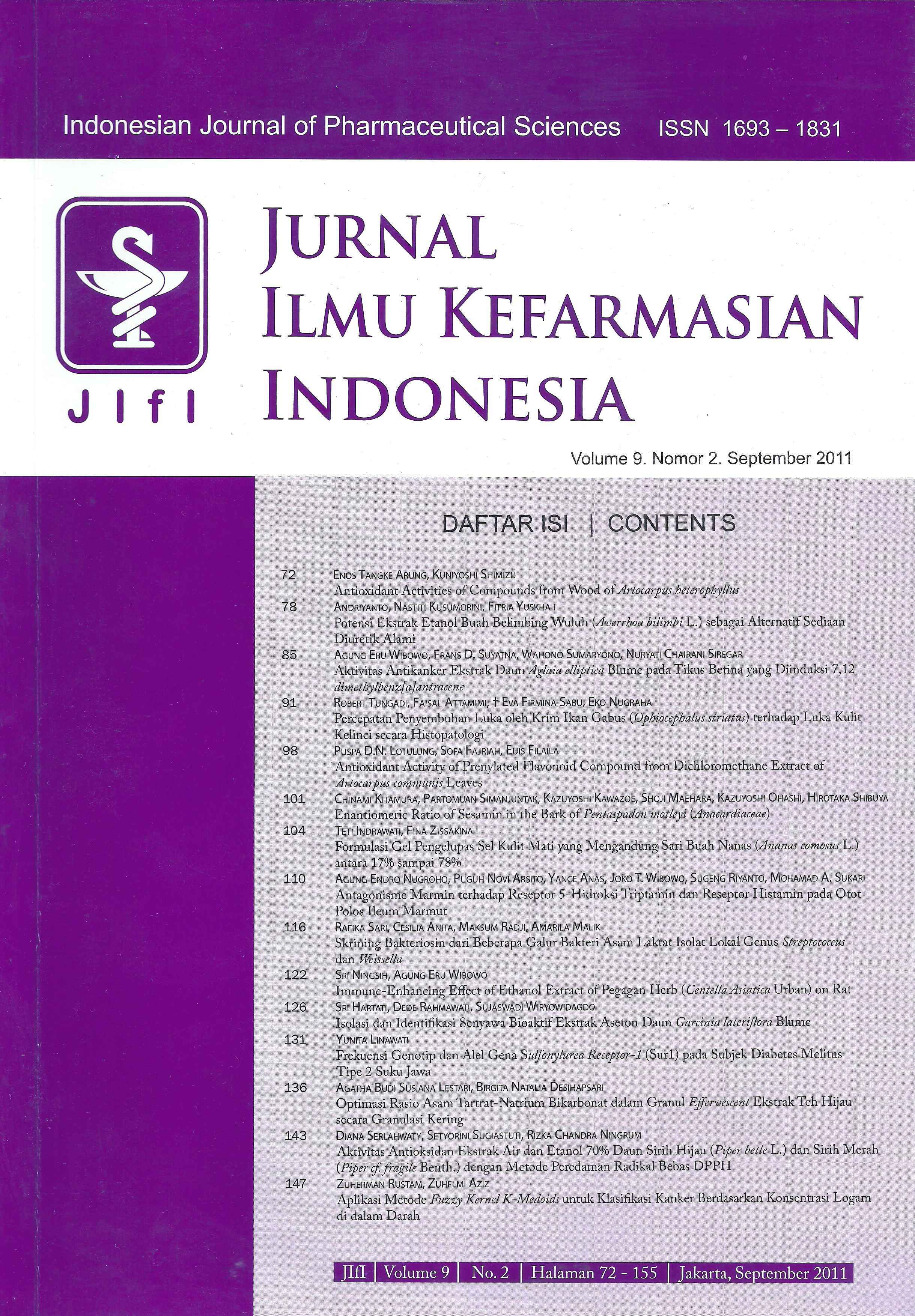
Optimasi Rasio Asam Tartrat-Natrium Bikarbonat dalam Granul Effervescent Ekstrak Teh Hijau secara Granulasi Kering
Kata Kunci:
ekstrak teh hijau, asam tartrat, natrium bikarbonat, granul effervescent, granulasi keringAbstrak
Tujuan dari penelitian ini adalah untuk mengetahui pengaruh asam tartrat, natrium bikarbonat dan interaksinya terhadap sifat fisik granul effervescent ekstrak teh hijau yang dibuat secara granulasi kering serta untuk mengetahui area komposisi optimum campuran asam tartrat dan natrium bikarbonat yang menghasilkan granul effervescent yang memenuhi persyaratan kualitas. Penelitian eksperimental ini menggunakan desain faktorial dua faktor, yaitu asam tartrat dan natrium bikarbonat, dan dua level, yaitu level tinggi dan level rendah. Optimasi dilakukan terhadap sifat fisik granul yang meliputi kecepatan alir granul, kandungan lembab granul, waktu larut granul serta pH larutan. Metode analisis statistik yang digunakan adalah Yate’s treatment dengan taraf kepercayaan 95%. Hasil penelitian ini menunjukkan bahwa asam tartrat merupakan faktor yang dominan dalam menentukan respons waktu larut granul effervescent, sementara natrium bikarbonat merupakan faktor yang dominan dalam menentukan respon kandungan lembab granul effervescent. Interaksi antara asam tartrat dan natrium bikarbonat berpengaruh signifikan terhadap respons kecepatan alir granul dan pH larutan. Contour plot superimposed tidak dapat dibuat karena adanya salah satu sifat fisik granul effervescent yang tak terpenuhi, yaitu kandungan lembab granul, sehingga tidak dapat diperoleh area komposisi optimum campuran asam tartrat dan natrium bikarbonat yang menghasilkan granul effervescent yang memenuhi persyaratan kualitas.
Referensi
Unduhan
Diterbitkan
Terbitan
Bagian
Lisensi
Licencing
All articles in Jurnal Ilmu Kefarmasian Indonesia are an open-access article, distributed under the terms of the Creative Commons Attribution-NonCommercial-ShareAlike 4.0 International License which permits unrestricted non-commercial used, distribution and reproduction in any medium.
This licence applies to Author(s) and Public Reader means that the users mays :
- SHARE:
copy and redistribute the article in any medium or format - ADAPT:
remix, transform, and build upon the article (eg.: to produce a new research work and, possibly, a new publication) - ALIKE:
If you remix, transform, or build upon the article, you must distribute your contributions under the same license as the original. - NO ADDITIONAL RESTRICTIONS:
You may not apply legal terms or technological measures that legally restrict others from doing anything the license permits.
It does however mean that when you use it you must:
- ATTRIBUTION: You must give appropriate credit to both the Author(s) and the journal, provide a link to the license, and indicate if changes were made. You may do so in any reasonable manner, but not in any way that suggests the licensor endorses you or your use.
You may not:
- NONCOMMERCIAL: You may not use the article for commercial purposes.

This work is licensed under a Creative Commons Attribution-NonCommercial-ShareAlike 4.0 International License.