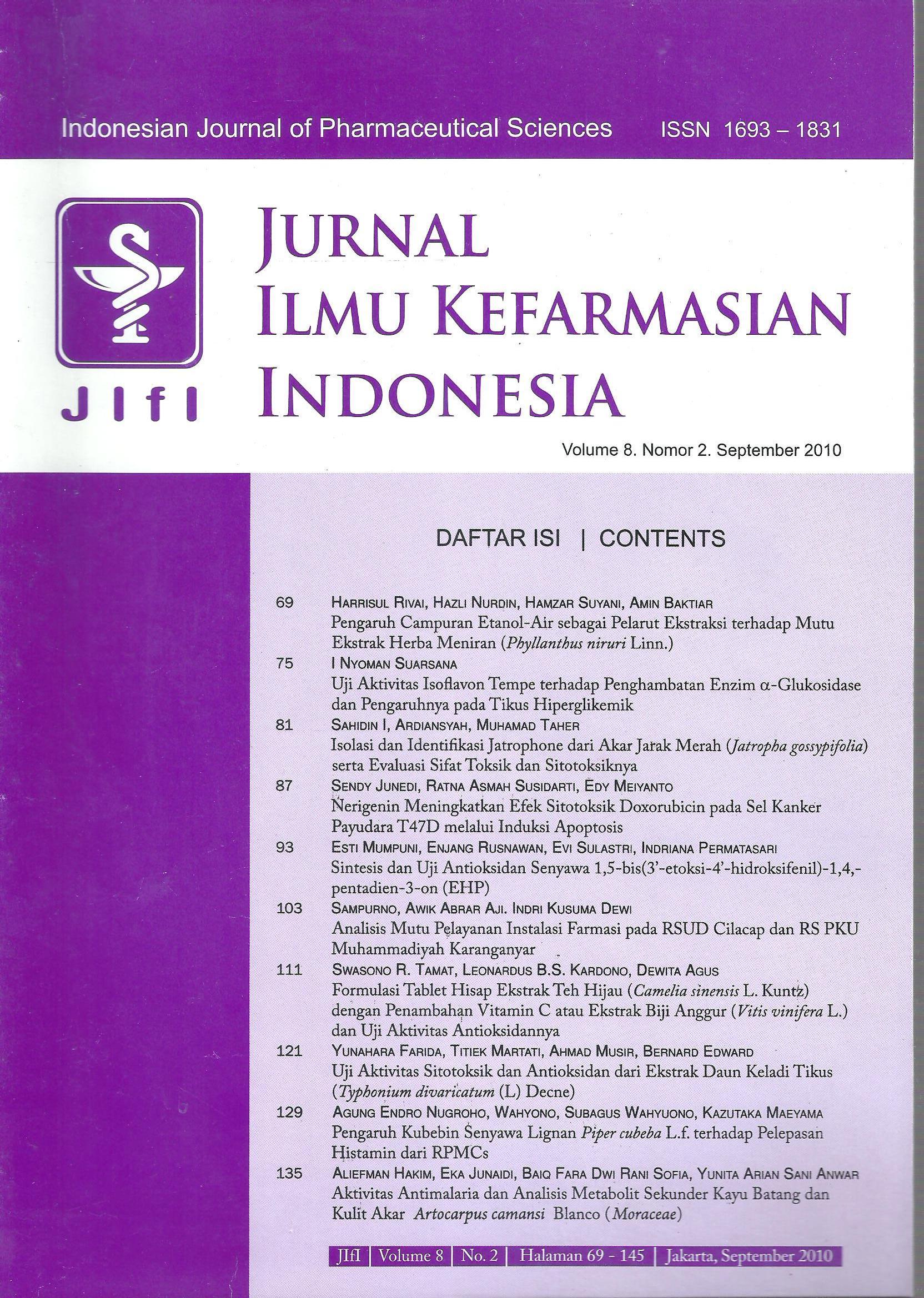
Peningkatan Efek Sitotoksik Doxorubicin oleh Naringenin pada Sel Kanker Payudara T47D melalui Induksi Apoptosis
Abstrak
Doxorubicin masih digunakan sebagai regimen standar kemoterapi kanker payudara, tetapi resistensi terhadap agen ini sering ditemukan, dan pengunaannya dalam jangka waktu larna dapat menimbulkan kardiotoksisitas. Karena itu, agen kombinasi (ko-kemoterapi) perlu dikembangkan untuk meningkatkan efektivitas doxorubicin dan mengurangi toksisitas sistemiknya. Naringenin, salah satu flavonoid yang melimpah di kulit buah jenlk, memiliki cfck sitotoksik pada berbagai sel kanker dan mekanismenya melalui jalur selain p53. Penelitian ini bertujuan untuk mengetahui efek naringenin yang dikombinasikan dengan doxorubicin pada sel T47D, model sel kanker payudara yang resisten terhadap doxorubicin karena rnemiliki p53 termutasi. Nilai IC50 dan CI (combination index, indeks kombinasi) ditetapkan dcngan uji MTT. Efek pemacuan apoptosis naringenin dan doxorubicin diamati dengan pengecatan DNA menggunakan etidium bromida-akridin oranye. Naringenin dan doxorubicin memberikan efek sitotoksik dengan nilai IC50 masing-masing 509 µM dan 15 nM. Nilai Cl pada berbagai rasio naringenin-doxorubicin menunjukkan efek sinergis (CI = 0,20-0,89). Pada konsentrasi kombinasi naringenin-doxorubicin yang lebih kccil dari 12,5 µM-0,6 nM dengan rasio 1:1 akan diperoleh efek kombinasi aditif, Perlakuan kombinasi meningkatkan efek apoptosis dari doxorubicin. Penelitian ini menyimpulkan bahwa naringenin berpotensi untuk dikembangkan sebagai agen ko-kemoterapi bersama doxorubicin, namun tetap dibutuhkan penelusuran rnekanisme moleloiler lebih lanjut.
Referensi
Unduhan
Diterbitkan
Terbitan
Bagian
Lisensi
Licencing
All articles in Jurnal Ilmu Kefarmasian Indonesia are an open-access article, distributed under the terms of the Creative Commons Attribution-NonCommercial-ShareAlike 4.0 International License which permits unrestricted non-commercial used, distribution and reproduction in any medium.
This licence applies to Author(s) and Public Reader means that the users mays :
- SHARE:
copy and redistribute the article in any medium or format - ADAPT:
remix, transform, and build upon the article (eg.: to produce a new research work and, possibly, a new publication) - ALIKE:
If you remix, transform, or build upon the article, you must distribute your contributions under the same license as the original. - NO ADDITIONAL RESTRICTIONS:
You may not apply legal terms or technological measures that legally restrict others from doing anything the license permits.
It does however mean that when you use it you must:
- ATTRIBUTION: You must give appropriate credit to both the Author(s) and the journal, provide a link to the license, and indicate if changes were made. You may do so in any reasonable manner, but not in any way that suggests the licensor endorses you or your use.
You may not:
- NONCOMMERCIAL: You may not use the article for commercial purposes.

This work is licensed under a Creative Commons Attribution-NonCommercial-ShareAlike 4.0 International License.