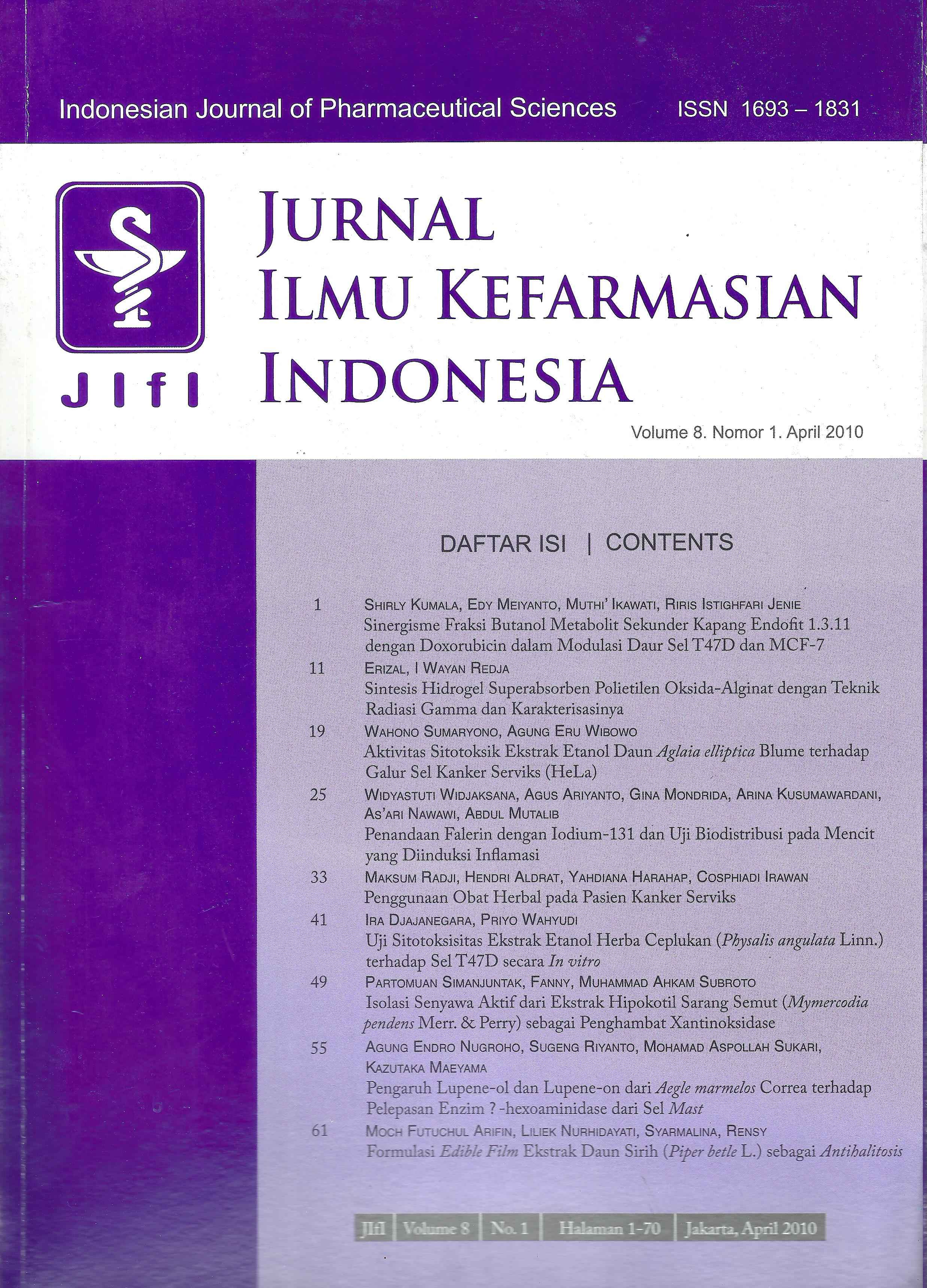
Sintesis Hidrogel Superabsorben Polietilen Oksida-Alginat dengan Teknik Radiasi Gamma dan Karakterisasinya
Kata Kunci:
Alginate, polyethylene oxide, irradiation, hydrogel, superabsorbentAbstrak
Abstract: In order to develop the applications of radiation for biomaterial preparation, a non-toxic superabsorbent has been synthesized. A series of superbasorbent hydrogel were prepared from aqueous solution containing 5% polyethylene oxide (PEO) with different concentration of alginate (0.5-2.0%) were irradiated at the doses of 20, 30, and 40 kGy by gamma radiation.The gel fraction, swelling kinetics and the equilibrium degree of swelling (EDS) of the hydrogels were studied, It was found that the incorporation of even 2% alginate (sodium salt) increased the EDS of the hydrogels from 20g/g to 320 g/ g. At a dose of 20 kGy, PEO-alginat hydrogels with high gel fraction ( Ì´ 8O%) and very high EDS ( Ì´ 320 g/g) were obtained. The hydrogels were also found to be sensitive to the ionic solution of NaCl. The PEO-alginate hydrogels could be considered as candidate biomaterials in health care.
Referensi
Unduhan
Diterbitkan
Terbitan
Bagian
Lisensi
Licencing
All articles in Jurnal Ilmu Kefarmasian Indonesia are an open-access article, distributed under the terms of the Creative Commons Attribution-NonCommercial-ShareAlike 4.0 International License which permits unrestricted non-commercial used, distribution and reproduction in any medium.
This licence applies to Author(s) and Public Reader means that the users mays :
- SHARE:
copy and redistribute the article in any medium or format - ADAPT:
remix, transform, and build upon the article (eg.: to produce a new research work and, possibly, a new publication) - ALIKE:
If you remix, transform, or build upon the article, you must distribute your contributions under the same license as the original. - NO ADDITIONAL RESTRICTIONS:
You may not apply legal terms or technological measures that legally restrict others from doing anything the license permits.
It does however mean that when you use it you must:
- ATTRIBUTION: You must give appropriate credit to both the Author(s) and the journal, provide a link to the license, and indicate if changes were made. You may do so in any reasonable manner, but not in any way that suggests the licensor endorses you or your use.
You may not:
- NONCOMMERCIAL: You may not use the article for commercial purposes.

This work is licensed under a Creative Commons Attribution-NonCommercial-ShareAlike 4.0 International License.