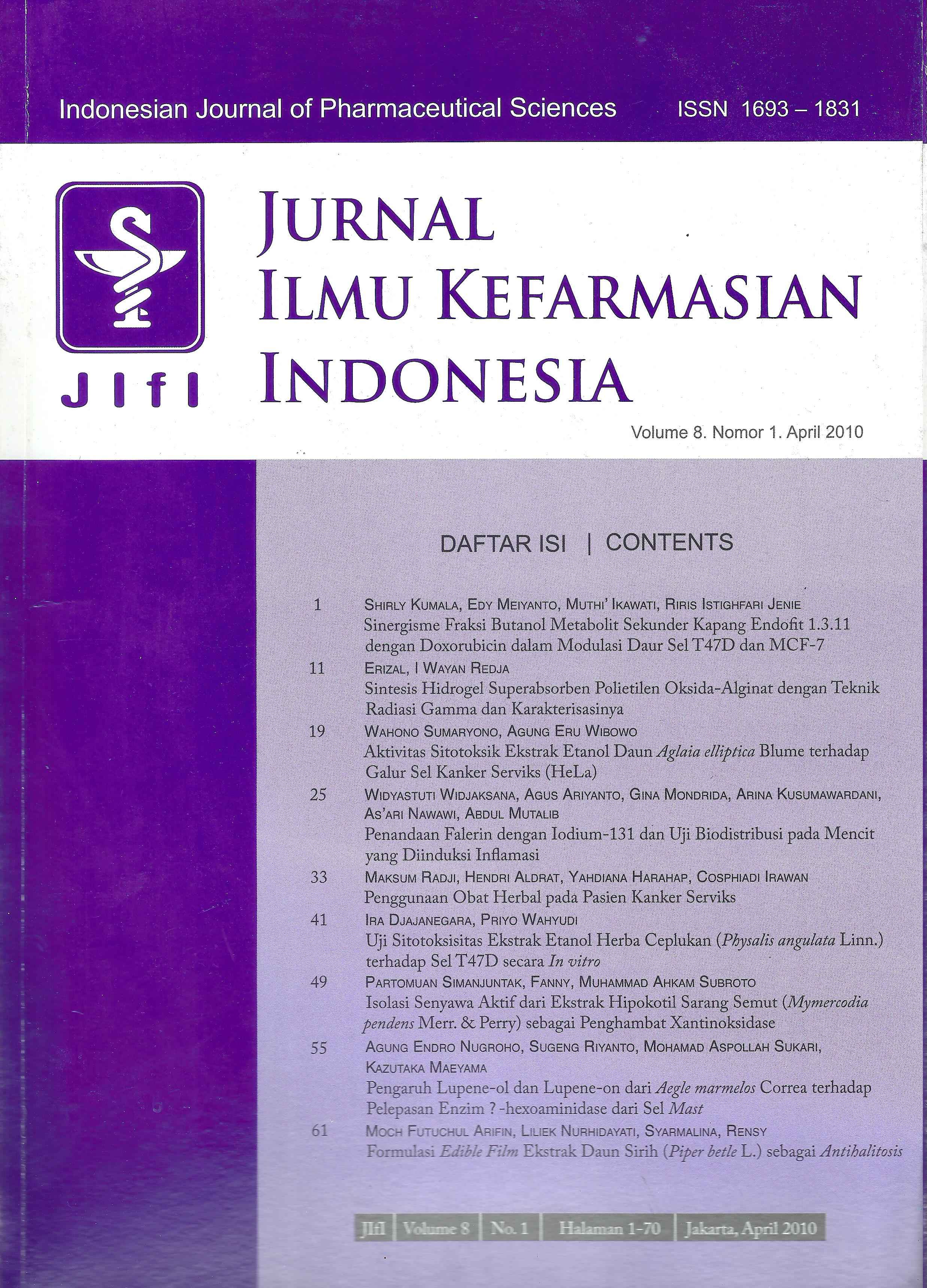
Uji Sitotoksisitas Ekstrak Etanol Herba Ceplukan (Physalis angulata Linn.) terhadap Sel T47D secara In Vitro
Kata Kunci:
fruit, cutleaf groundcherry (Physalis angulam), citotoxicity, T47D (breast cancer) cell linesAbstrak
Cutleaf groundcheny (Physalis angulata Linn.) is a popular traditional medicine. This experiment was conducted to investigate the possible role of the herbal extract as an anticancer agent using T47D breast cancer cell line. Cytotoxicity assay was caried out by direct counting method. Breastcancer T47D cell lines Were treated with 70% ethanol extract from cutleaf groundcherry fruit with serial dilution of 2000, 1000, 500, 250, 125, 62.5, and 31.25 µg/ml for 24 hours of incubation at 37°C As a positive control doxorubicin was also tested on the breast cancer T47D cell lines with serial dilution of 20, 10, 5, 2.5, 1.25, 0.625, 0.312, and 0.156 µg/ml for 24 hours of incubation at 37°C The amount of living cells were observed and counted, death percentage was then determined and probit analysis was used to determine the LC50 value. The LC50 value for ethanol extract from the fruits was 28,02 µg/ml While doxorubicin as the positive control was 0,113 µg/ml. It is concluded that the cutleaf groundcherry (Physalis angulata) fruits have a cytotoxic activity toward T47D (breast cancer) cell lines which confirmed previous toxicity experiment using brine shrimp lethality test (BSLT) method.
Referensi
Unduhan
Diterbitkan
Terbitan
Bagian
Lisensi
Licencing
All articles in Jurnal Ilmu Kefarmasian Indonesia are an open-access article, distributed under the terms of the Creative Commons Attribution-NonCommercial-ShareAlike 4.0 International License which permits unrestricted non-commercial used, distribution and reproduction in any medium.
This licence applies to Author(s) and Public Reader means that the users mays :
- SHARE:
copy and redistribute the article in any medium or format - ADAPT:
remix, transform, and build upon the article (eg.: to produce a new research work and, possibly, a new publication) - ALIKE:
If you remix, transform, or build upon the article, you must distribute your contributions under the same license as the original. - NO ADDITIONAL RESTRICTIONS:
You may not apply legal terms or technological measures that legally restrict others from doing anything the license permits.
It does however mean that when you use it you must:
- ATTRIBUTION: You must give appropriate credit to both the Author(s) and the journal, provide a link to the license, and indicate if changes were made. You may do so in any reasonable manner, but not in any way that suggests the licensor endorses you or your use.
You may not:
- NONCOMMERCIAL: You may not use the article for commercial purposes.

This work is licensed under a Creative Commons Attribution-NonCommercial-ShareAlike 4.0 International License.