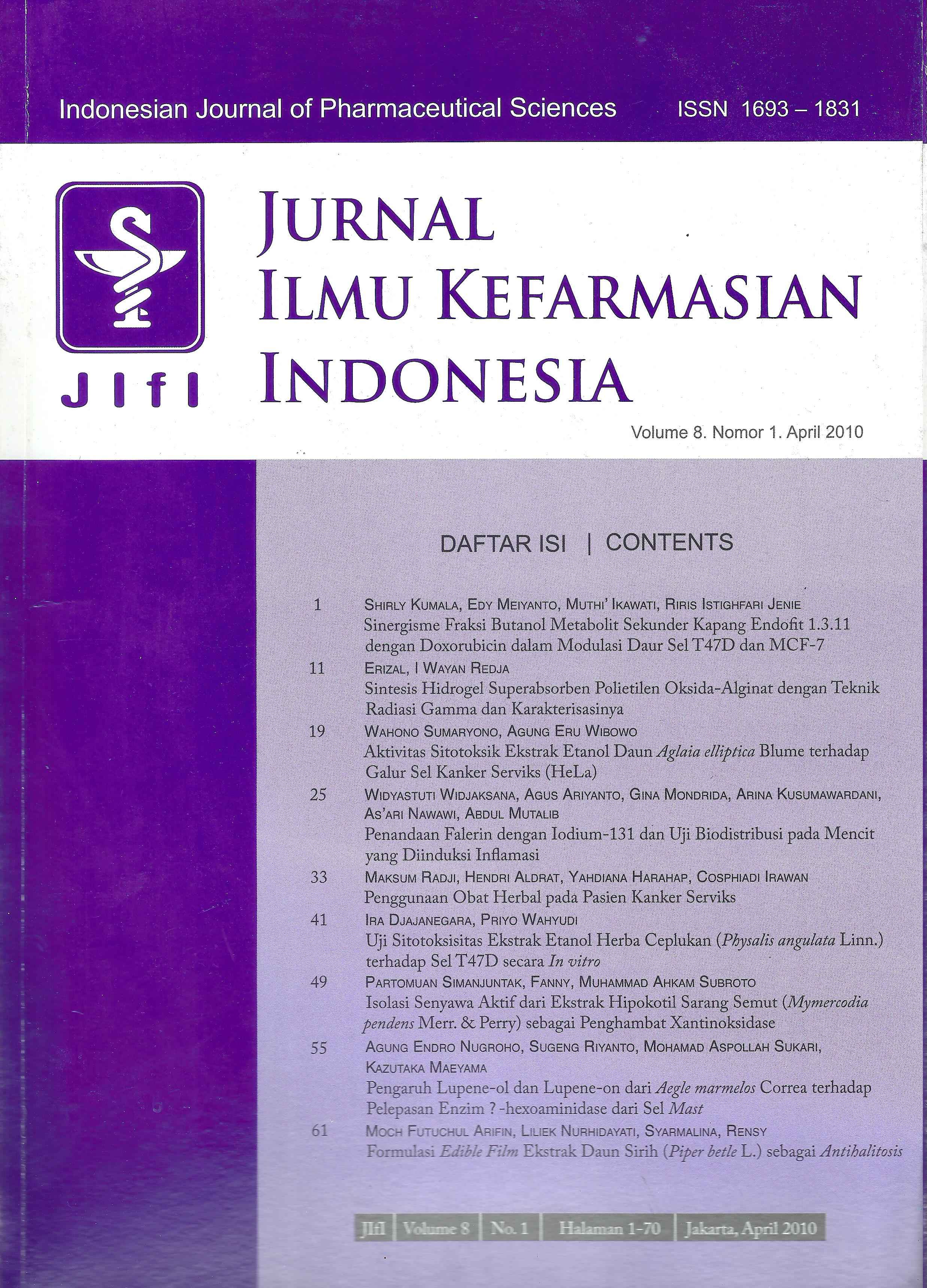
Formulasi Edible Film Ekstrak Daun Sirih (Piper betle L.) sebagai Antihalitosis
Kata Kunci:
Halitosis, edible film, Piper betle (Sirih leaves) extract, optimum formulaAbstrak
Halitosis (bad breath) is the most complained problem among mouth and teeth health. The source of halitosis are volatile sulfur compounds produced by Streptococcus mutans from degradation of food debris. Sirih leaves (Pqaer betle L.) are traditionally used as mouth antiseptic for its volatile oil. The aim of this research was to formulate sirih extract into an edible film. The leaves were macerated with 96% ethanol for 24 hours, resulting to an extract with minimum inhibitory concentration (MIC) on Streptococcus mutans of 8.49x10⁻³ g/ml. The extract with strength quadruple of the MIC, or equal to 0.92% povidone iodine, was formulated using 23 factorial design. Com starch, hydroxypropyl methylcellulose (HPMC) and sorbitol were independent variables and drying time, moisture, hlm thickness, disintegrating time, and iilrn strength were the dependent ones. The results showed that HPMC significantly fastened the drying time, decreased the moisture, and lengthened the disintegrating time. Sorbitol significantly lengthened the drying time, increased the moisture, and strengthened the film, while corn starch decreased the moisture and lengthened the disintegrating time. Optimation of the formula ingredients using contour plot superimposed cannot be determined due to edible film disintegrating time that was out of comparative interval.
Referensi
Unduhan
Diterbitkan
Terbitan
Bagian
Lisensi
Licencing
All articles in Jurnal Ilmu Kefarmasian Indonesia are an open-access article, distributed under the terms of the Creative Commons Attribution-NonCommercial-ShareAlike 4.0 International License which permits unrestricted non-commercial used, distribution and reproduction in any medium.
This licence applies to Author(s) and Public Reader means that the users mays :
- SHARE:
copy and redistribute the article in any medium or format - ADAPT:
remix, transform, and build upon the article (eg.: to produce a new research work and, possibly, a new publication) - ALIKE:
If you remix, transform, or build upon the article, you must distribute your contributions under the same license as the original. - NO ADDITIONAL RESTRICTIONS:
You may not apply legal terms or technological measures that legally restrict others from doing anything the license permits.
It does however mean that when you use it you must:
- ATTRIBUTION: You must give appropriate credit to both the Author(s) and the journal, provide a link to the license, and indicate if changes were made. You may do so in any reasonable manner, but not in any way that suggests the licensor endorses you or your use.
You may not:
- NONCOMMERCIAL: You may not use the article for commercial purposes.

This work is licensed under a Creative Commons Attribution-NonCommercial-ShareAlike 4.0 International License.