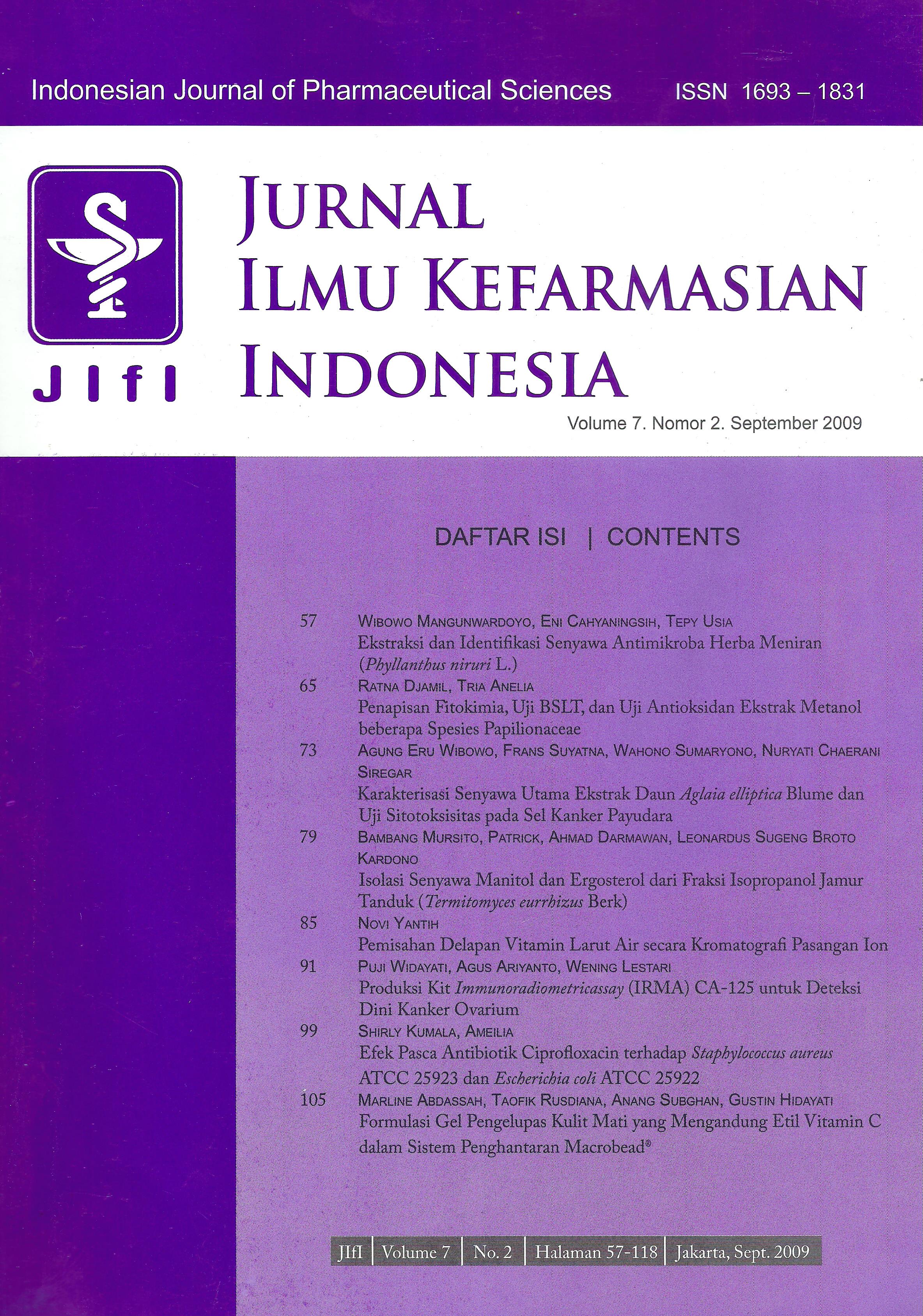
Formulasi Gel Pengelupas Kulit Mati yang Mengandung Etil Vitamin C dalam Sistem Penghantaran Macrobead®
Kata Kunci:
ethyl vitamin C, acrylates copolymer gel, carboxy vinyl polymer, Macrobead®Abstrak
To recover good appearance of skin, dead skin cells should be removed, among others by using exfoliating agent, and to preserve the fresh skin ethyl vitamin C could be used as an antioxidant. Formulation and evaluation of skin exfoliating gel containing ethyl vitamin C in Macrobead® delivery system, using acrylates copolymer and carboxy vinyl polymer as gel bases have been carried out. The gel evaluation included physical evaluation and safety examination. The results showed that ethyl vitamin C could be trapped into Macrobead® system with good absorption inthe ratio of active content and Macrobead® of 3:4. Based on the physical evaluation of the gel formula, it was found that formula with acrylates copolymer base has altered the consistency and homogenity of gels, but not the formula with carboxy vinyl polymer base. Gels using carboxy vinyl polymer showed good physical stability for28 days of storage. The safety evaluation indicated that the preparation was safe to be used for it did not cause irritation on consumers skin. The examination showed that the preparation could exfoliate dead skin cells and thus freshen the users’ skin effectively.
Referensi
Unduhan
Diterbitkan
Terbitan
Bagian
Lisensi
Licencing
All articles in Jurnal Ilmu Kefarmasian Indonesia are an open-access article, distributed under the terms of the Creative Commons Attribution-NonCommercial-ShareAlike 4.0 International License which permits unrestricted non-commercial used, distribution and reproduction in any medium.
This licence applies to Author(s) and Public Reader means that the users mays :
- SHARE:
copy and redistribute the article in any medium or format - ADAPT:
remix, transform, and build upon the article (eg.: to produce a new research work and, possibly, a new publication) - ALIKE:
If you remix, transform, or build upon the article, you must distribute your contributions under the same license as the original. - NO ADDITIONAL RESTRICTIONS:
You may not apply legal terms or technological measures that legally restrict others from doing anything the license permits.
It does however mean that when you use it you must:
- ATTRIBUTION: You must give appropriate credit to both the Author(s) and the journal, provide a link to the license, and indicate if changes were made. You may do so in any reasonable manner, but not in any way that suggests the licensor endorses you or your use.
You may not:
- NONCOMMERCIAL: You may not use the article for commercial purposes.

This work is licensed under a Creative Commons Attribution-NonCommercial-ShareAlike 4.0 International License.