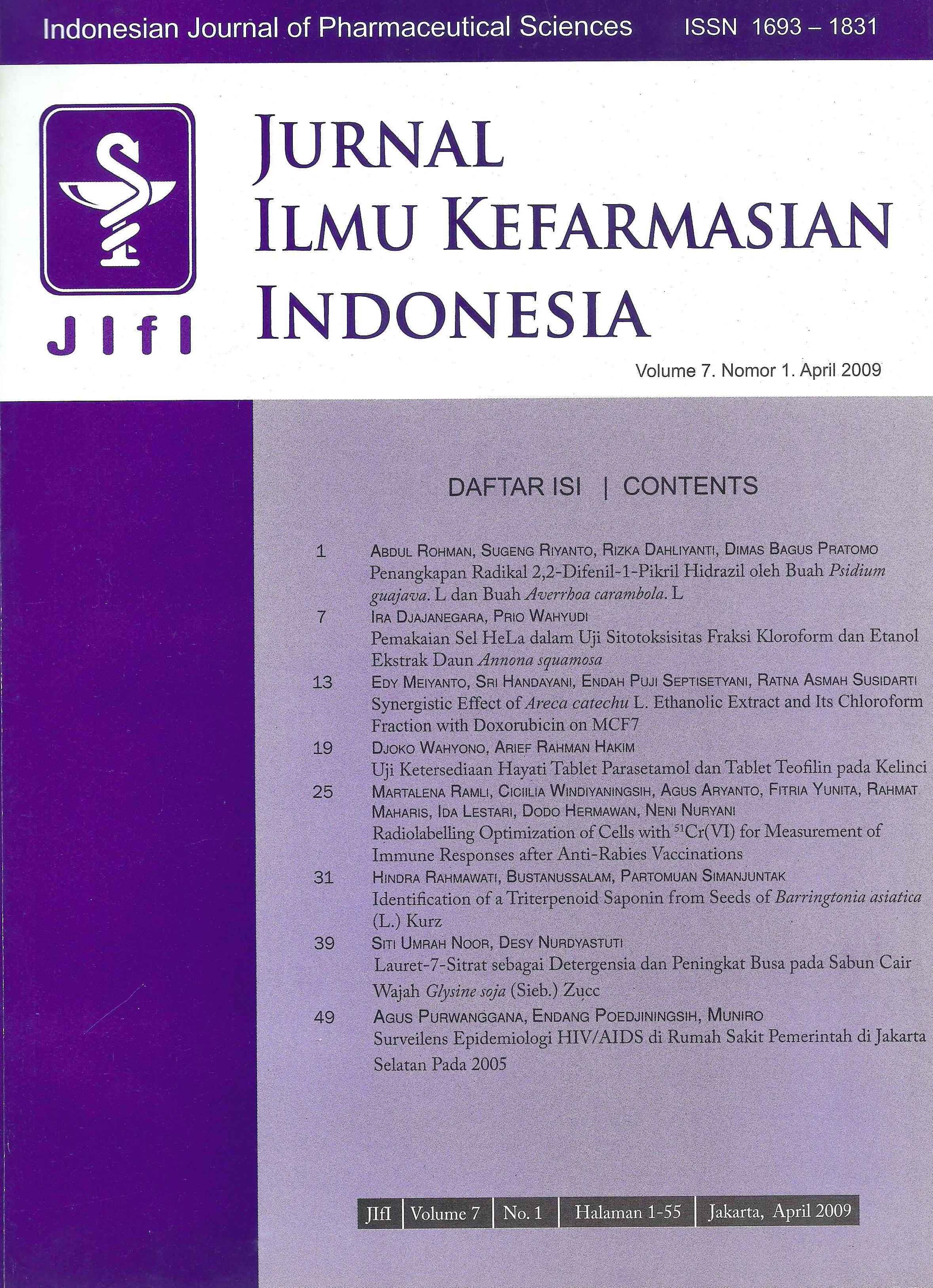
Penangkapan Radikal 2,2-Difenil-1-Pikril Hidrazil oleh Ekstrak Buah Psidium guajava. L dan Averrhoa carambola L.
Kata Kunci:
Psidium guajava L., Averrhoa carambola L., 2,2-diphenyl-1-picrylhidrazyl (DPPH)Abstrak
Two fruits, Guava (Psidium guajava L.) and Carambola (Averrhoa cammbola L.), Which are frequently consumed by Indonesian people, have been evaluated for its activities as 2,2-diphenyl-1-picrylhidrazyl (DPPH) radical scavenging. The fruits were macerated, evaporated, dissolved in Water, partitioned with chloroform and then with aethyl acetate to afford methanolic extract and fractions of chloroform, aethyl acetate, and Water respectively. Total phenolic and total flavonoid contents of each extract and fraction Were determined by spectrophotometric technique and used to evaluate the correlation between the natural chemical contents and their activities as DPPH radical scavengers. The results showed that extracts and fractions of R guajava L. fruit have more ability to scavenge 2,2-diphenyl- 1-picrylhidrazyl (DPPH) radical than those of A. carambola L. The total phenolic and total flavonoid contents of extracts and fractions of R guajava L. fruit are also higher than those of A. cammbola L.
Referensi
Unduhan
Diterbitkan
Terbitan
Bagian
Lisensi
Licencing
All articles in Jurnal Ilmu Kefarmasian Indonesia are an open-access article, distributed under the terms of the Creative Commons Attribution-NonCommercial-ShareAlike 4.0 International License which permits unrestricted non-commercial used, distribution and reproduction in any medium.
This licence applies to Author(s) and Public Reader means that the users mays :
- SHARE:
copy and redistribute the article in any medium or format - ADAPT:
remix, transform, and build upon the article (eg.: to produce a new research work and, possibly, a new publication) - ALIKE:
If you remix, transform, or build upon the article, you must distribute your contributions under the same license as the original. - NO ADDITIONAL RESTRICTIONS:
You may not apply legal terms or technological measures that legally restrict others from doing anything the license permits.
It does however mean that when you use it you must:
- ATTRIBUTION: You must give appropriate credit to both the Author(s) and the journal, provide a link to the license, and indicate if changes were made. You may do so in any reasonable manner, but not in any way that suggests the licensor endorses you or your use.
You may not:
- NONCOMMERCIAL: You may not use the article for commercial purposes.

This work is licensed under a Creative Commons Attribution-NonCommercial-ShareAlike 4.0 International License.