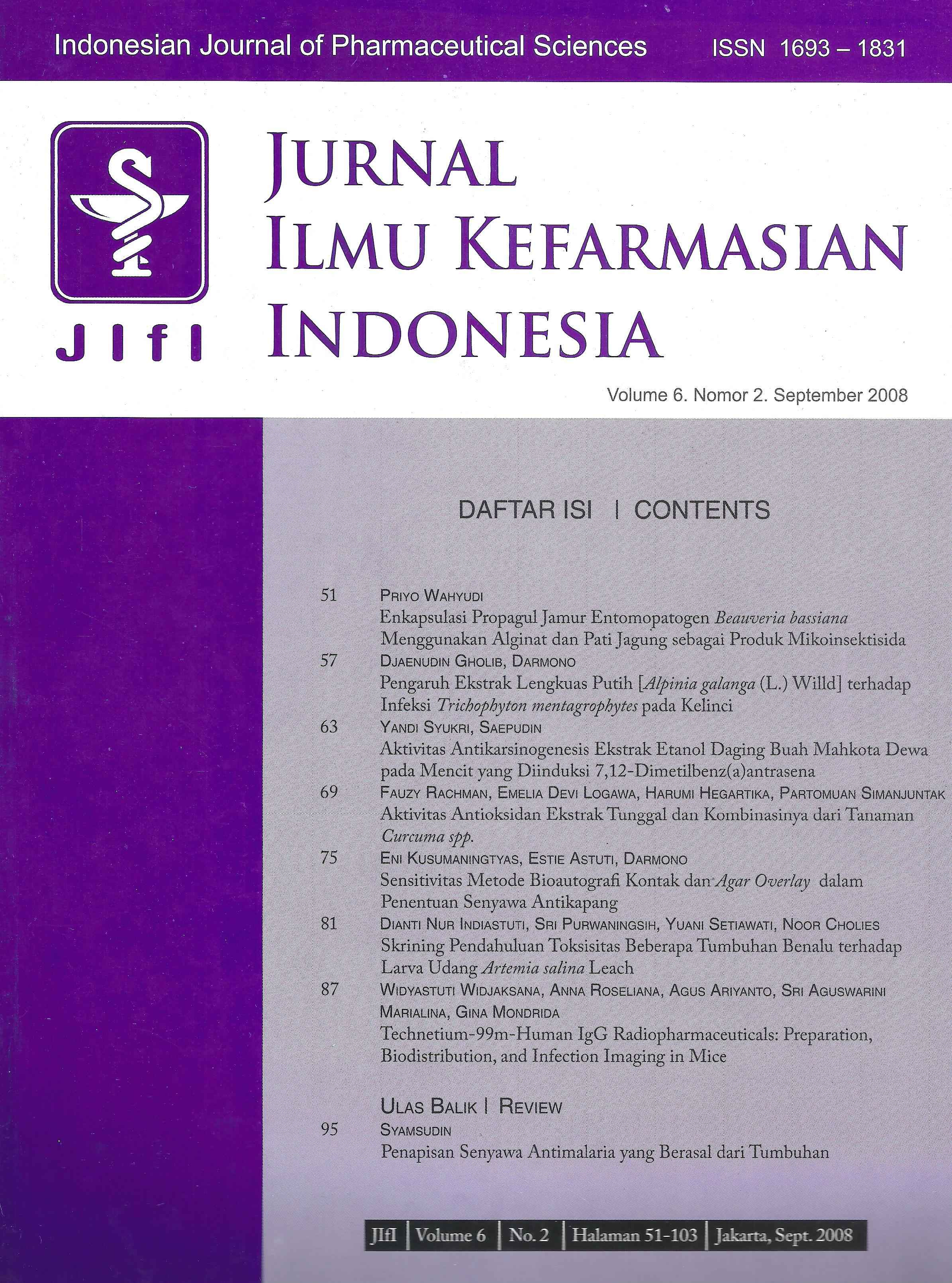
Skrining Pendahuluan Toksisitas Beberapa Tumbuhan Benalu terhadap Larva Udang Artemia Salina Leach
Kata Kunci:
Brine shrimp lethality test, Artemia Salina Leach, tumbuhan benaluAbstrak
The brine shrimp lethality test (BSLT) is considered as a useful tool for preliminary assessment of toxicity. It has also been suggested for screening of pharmacological activities of plant extracts. The bioactivity of eight methanol extracts of four parasite plants and two host plants were evaluated using the brine shrimp lethality assay. The results showed that all methanol extracts of the host plants did not have any indication of toxicity The LC50 of methanol extract of Moringa pterygosperma stem was 1085.44±84.32 µg/ml, and of Ficus refusal stem was 1240.86±50.71 µg/ml. But methanol extracts of whole parts of parasite plants showed toxicity to Artemia Salina Leach. The LC50 of methanol extract of Loranthus peretandrus herb parasite was 175.66±29,24 µg/ml while that of Elytranthe evenia leaf parasite was 327.15±38.66 µg/ml; of Elytranthe evenia stem parasite was 320.39±39.57 µg/ml; of Elytranthe evenia flower parasite was 456.79±15.69 µg/ml; of Scurulla atropurpurea herb parasite was 176.44±28.46 µg/ml; and of Viscum articulatum parasite was 53.79±10.83 µg/ml.
Referensi
Unduhan
Diterbitkan
Terbitan
Bagian
Lisensi
Licencing
All articles in Jurnal Ilmu Kefarmasian Indonesia are an open-access article, distributed under the terms of the Creative Commons Attribution-NonCommercial-ShareAlike 4.0 International License which permits unrestricted non-commercial used, distribution and reproduction in any medium.
This licence applies to Author(s) and Public Reader means that the users mays :
- SHARE:
copy and redistribute the article in any medium or format - ADAPT:
remix, transform, and build upon the article (eg.: to produce a new research work and, possibly, a new publication) - ALIKE:
If you remix, transform, or build upon the article, you must distribute your contributions under the same license as the original. - NO ADDITIONAL RESTRICTIONS:
You may not apply legal terms or technological measures that legally restrict others from doing anything the license permits.
It does however mean that when you use it you must:
- ATTRIBUTION: You must give appropriate credit to both the Author(s) and the journal, provide a link to the license, and indicate if changes were made. You may do so in any reasonable manner, but not in any way that suggests the licensor endorses you or your use.
You may not:
- NONCOMMERCIAL: You may not use the article for commercial purposes.

This work is licensed under a Creative Commons Attribution-NonCommercial-ShareAlike 4.0 International License.