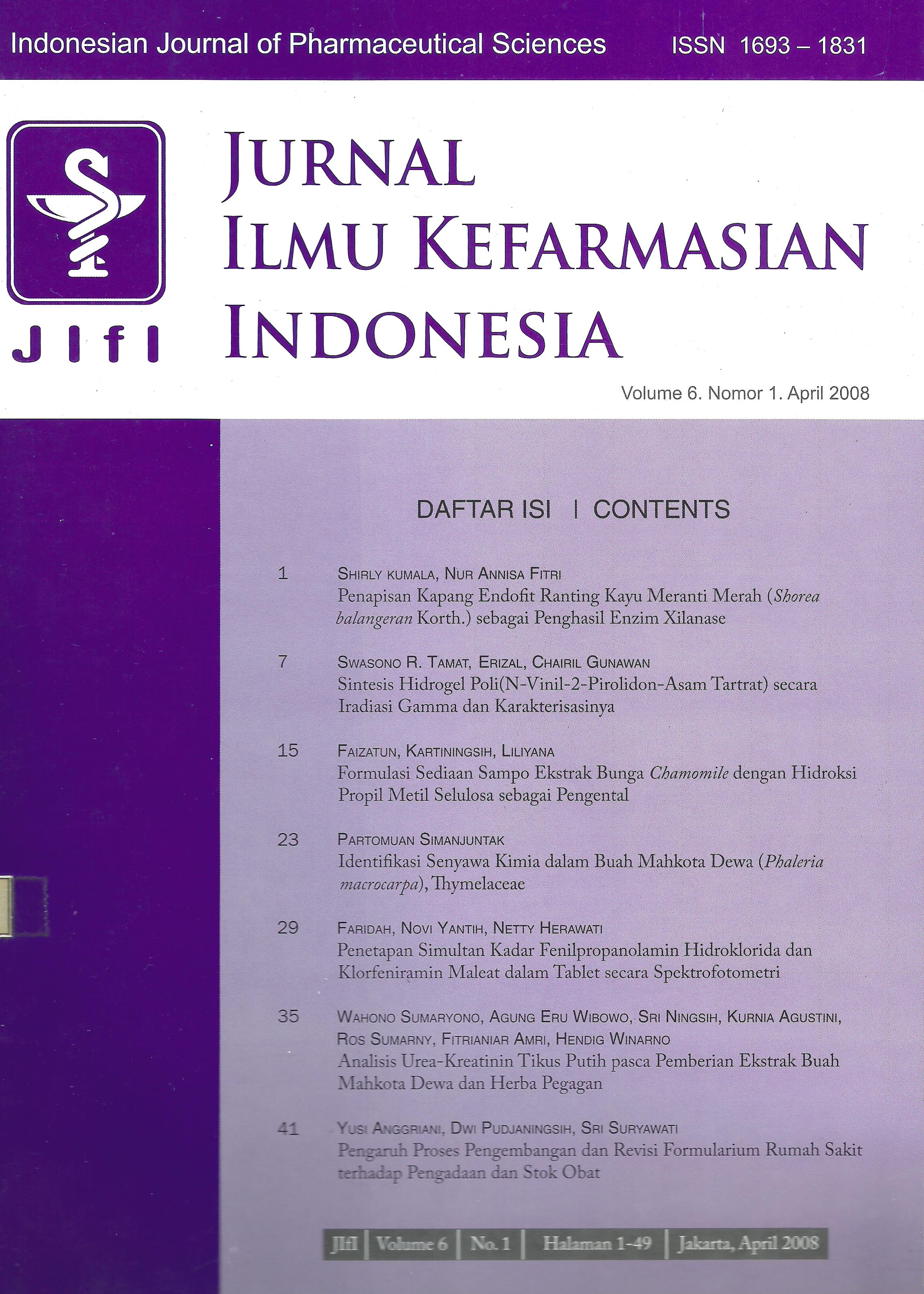
Pengaruh Proses Pengembangan dan Revisi Formularium Rumah Sakit terhadap Pengadaan dan Stok Obat
Kata Kunci:
formulary, drug selection, revisedAbstrak
Appropriate selection of medicines is needed to support its rational use. Medicines selection based upon a hospital formulary is an attempt to uncreate the medicine efficiency management. The objective of this study Was to evaluate and compare the intrinsic value of seven grade C-hospital formularies in Yogyakarta, also concerning the development and revision of the used fonnularies. The result showed that the percentage of purchase of non-formularium medicines and that of the non-formularium medicines in stock were influenced by the frequency of revision of the formulary itselfand drug policy in relation to the addition and deletion process of the used fonnulary. Non-formulary medicines purchase was low in hospitals which frequently revised the formulary, but hospital With no policy concerning addition and deletion increased the purchase of non formulary medicines. Besides that the use of brand name products in hospitals of the state was much lesser than that used in non-state hospitals (296-532 vs 573-1575). Fonnulary evaluation of state hospitals in comparison with non-state hospitals Were as follows: essential medicines (41-71% vs 20-28%), medicines with primary literature (73-90% vs 67-73%), drugs with single component (41-71% vs 20-28%) The quality of formulary in state and non-state grade C-hospitals in Yogyakarta must be improved.
Referensi
Unduhan
Diterbitkan
Terbitan
Bagian
Lisensi
Licencing
All articles in Jurnal Ilmu Kefarmasian Indonesia are an open-access article, distributed under the terms of the Creative Commons Attribution-NonCommercial-ShareAlike 4.0 International License which permits unrestricted non-commercial used, distribution and reproduction in any medium.
This licence applies to Author(s) and Public Reader means that the users mays :
- SHARE:
copy and redistribute the article in any medium or format - ADAPT:
remix, transform, and build upon the article (eg.: to produce a new research work and, possibly, a new publication) - ALIKE:
If you remix, transform, or build upon the article, you must distribute your contributions under the same license as the original. - NO ADDITIONAL RESTRICTIONS:
You may not apply legal terms or technological measures that legally restrict others from doing anything the license permits.
It does however mean that when you use it you must:
- ATTRIBUTION: You must give appropriate credit to both the Author(s) and the journal, provide a link to the license, and indicate if changes were made. You may do so in any reasonable manner, but not in any way that suggests the licensor endorses you or your use.
You may not:
- NONCOMMERCIAL: You may not use the article for commercial purposes.

This work is licensed under a Creative Commons Attribution-NonCommercial-ShareAlike 4.0 International License.