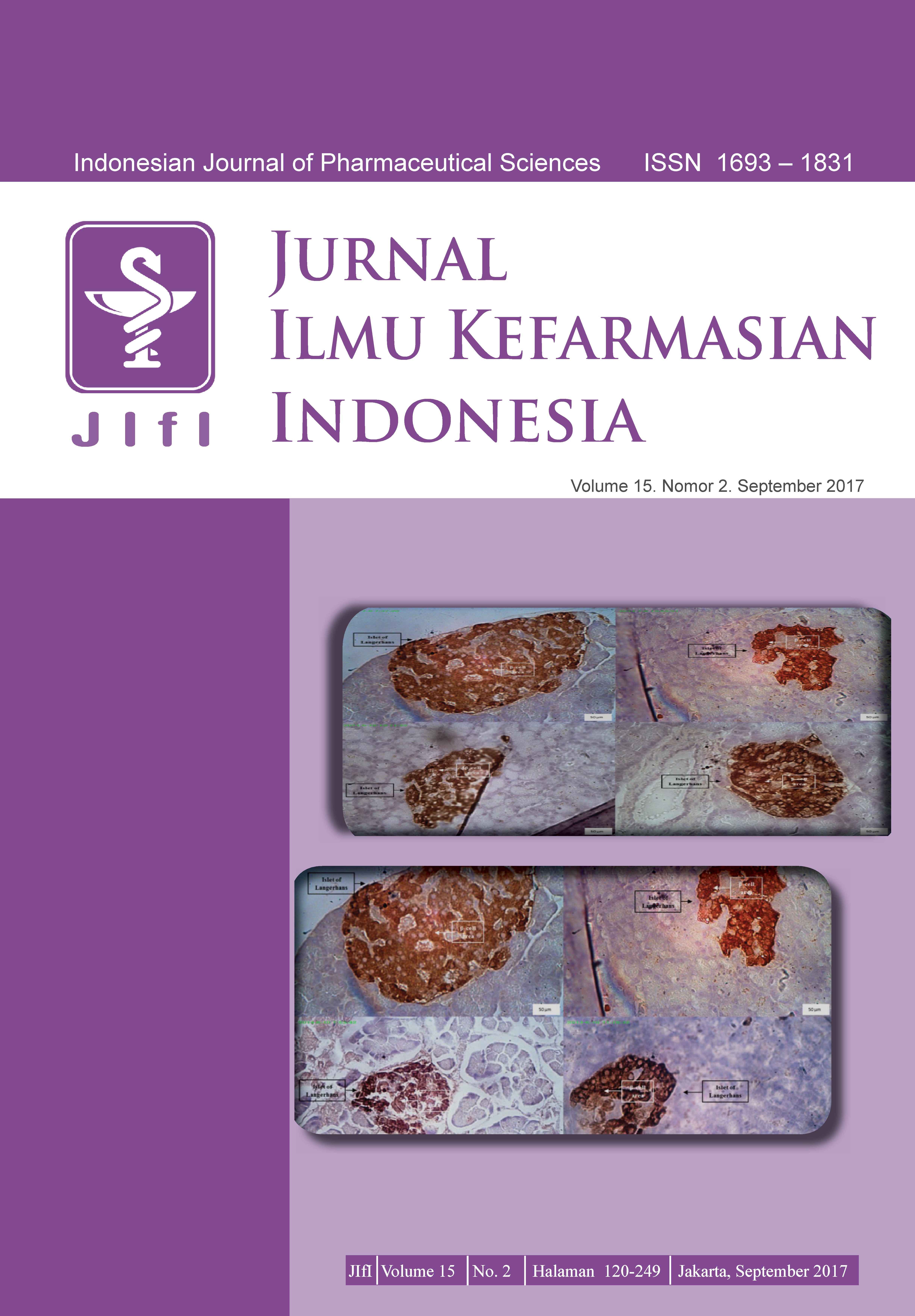
Efek Hepatoprotektor Ekstrak Etanol Daun Pucuk Merah (Syzygium campanulatum (Korth) dan Daun Cengkeh (Syzygium aromaticum (L.) Merr. & L. M. Perry) pada Tikus Jantan Galur Wistar (Rattus norvegicus) yang diinduksi Paracetamol
DOI:
https://doi.org/10.35814/jifi.v15i2.517Kata Kunci:
Hepatoprotektor, Syzygium campanulatum, Syzygium aromaticum, SGPT, SGOTAbstrak
Daun cengkeh dan daun pucuk merah mengandung komponen antioksidan seperti flavonoid,fenolik, dan terpenoid sehingga diduga memiliki efek hepatoprotektor dalam mengurangi SGPT dan SGOT. Penelitian ini bertujuan untuk mengetahui efek hepatoprotektor dan menentukan potensi hepatoprotektif dari ekstrak etanol daun pucuk merah dan daun cengkeh yang dibandingkan dengan tablet Curcuma. Penelitian ini menggunakan tikus jantan galur wistar yang dibagi menjadi 6 kelompok. Kelompok I, II, III (sebagai kontrol normal, kontrol induksi, dan kontrol pembanding), kelompok IV, V, VI diberi ekstrak uji dengan dosis 105, 210, dan 420 mg/kg BB. Penelitian dilakukan selama 9 hari. Setelah 7 hari diberi perlakuan, semua kelompok diberi parasetamol dosis hepatotoksik kecuali kelompok kontrol normal. Setelah 48 jam diinduksi oleh parasetamol, dilakukan pengukuran SGPT dan SGOT terhadap semua kelompok. Hasil penelitian dapat disimpulkan bahwa ekstrak daun pucuk merah mempunyai aktivitas sebagai hepatoprotektor pada dosis 210 mg/kg BB yang sebanding dengan tablet curcuma (SGPT 21,76±3,98 U/L dan SGOT 7,32±6,74 U/L) dan pada dosis 420 mg/kg BB ekstrak daun pucuk merah memiliki aktivitas hepatoprotektor yang lebih baik dari tablet curcuma (SGPT 12,43±6,51 U/L dan SGOT 6,64±5,88 U/L). Sedangkan ekstrak etanol daun cengkeh mempunyai aktivitas hepatoprotektor yang sebanding dengan tablet curcuma pada dosis 105, 210, dan 420 mg/kgBB.
Referensi
Unduhan
Diterbitkan
Terbitan
Bagian
Lisensi
Licencing
All articles in Jurnal Ilmu Kefarmasian Indonesia are an open-access article, distributed under the terms of the Creative Commons Attribution-NonCommercial-ShareAlike 4.0 International License which permits unrestricted non-commercial used, distribution and reproduction in any medium.
This licence applies to Author(s) and Public Reader means that the users mays :
- SHARE:
copy and redistribute the article in any medium or format - ADAPT:
remix, transform, and build upon the article (eg.: to produce a new research work and, possibly, a new publication) - ALIKE:
If you remix, transform, or build upon the article, you must distribute your contributions under the same license as the original. - NO ADDITIONAL RESTRICTIONS:
You may not apply legal terms or technological measures that legally restrict others from doing anything the license permits.
It does however mean that when you use it you must:
- ATTRIBUTION: You must give appropriate credit to both the Author(s) and the journal, provide a link to the license, and indicate if changes were made. You may do so in any reasonable manner, but not in any way that suggests the licensor endorses you or your use.
You may not:
- NONCOMMERCIAL: You may not use the article for commercial purposes.

This work is licensed under a Creative Commons Attribution-NonCommercial-ShareAlike 4.0 International License.