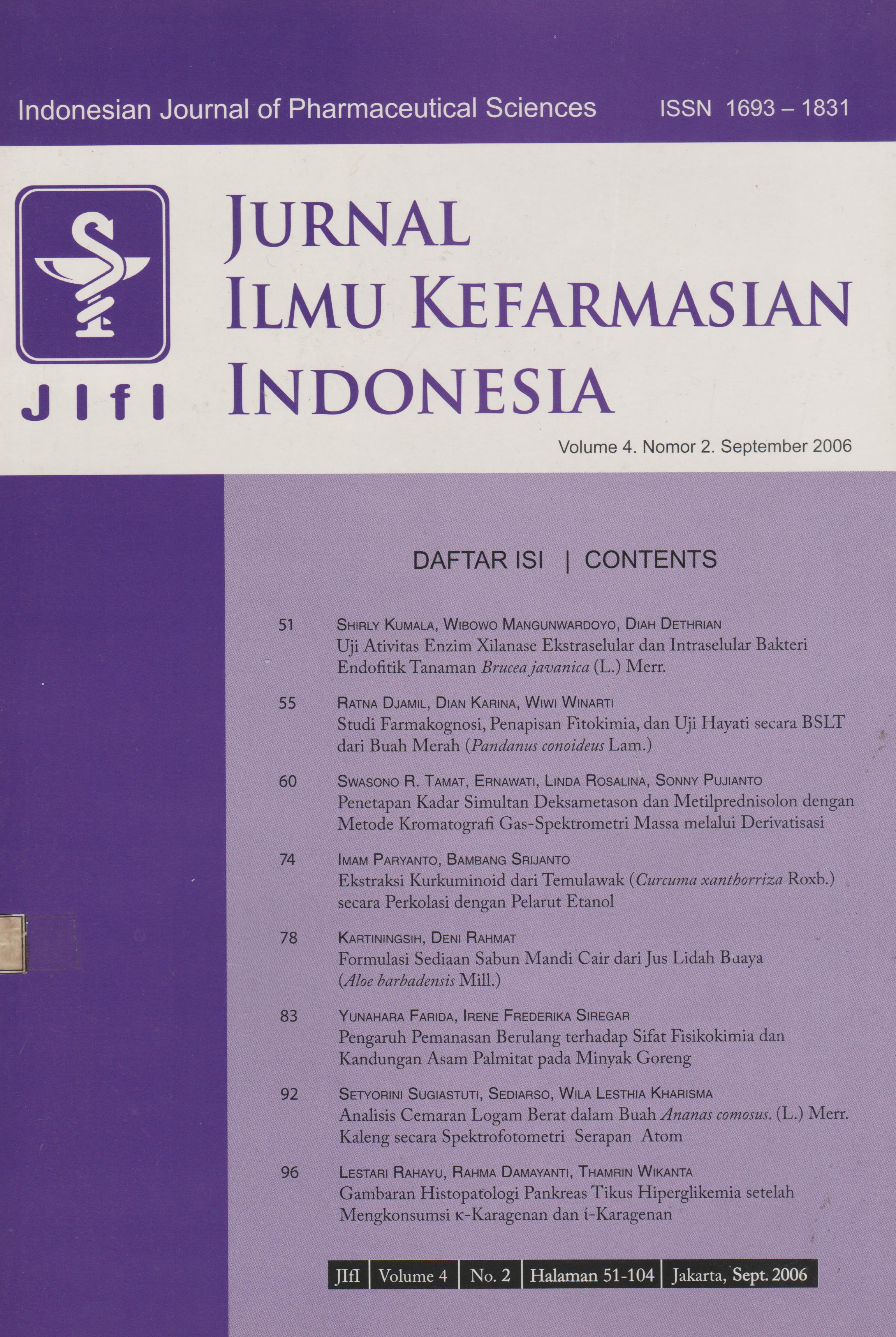
Penetapan Kadar Simultan Deksametason dan Metilprednisolon dengan Metode Kromatografi Gas Spektrometri Massa melalui Derivatisasi
Kata Kunci:
glucocorticosteroids, dexamethasone, methylprednisolone, D3-testosterone, gas chromatography-mass spectrometryAbstrak
This investigation is intended to find a simultaneous assay method for glucocorticosteroids declared as doping compound by the International Olympic Committee. Experiments were carried out in the determination of dexamethason and methylprednisolon in urine matrix by gas chromatography-mass spectrometry (GC-MS) using various derivatisation reagents, reaction temperature and time. Selection of the best derivatisation reagent was based on the separation of total ion chromatogram (TIC) and appearance of three characteristic ions, m/z 305, 345,680 or m/z 206,456, 662 for dexamethasone; and m/ z 279, 369, 459 or m/z 147, 424, 644 for methylprednisolone. Dexamethasone and methylprednisolone derivates in the GC-MS spectra were identified by characteristic ions of m/z 305 (dexamethasone) and m/ z 279 (methylprednisolone). The best derivatisation yield was achieved by a combination of TMSI - [BSTFA-TMCS (99:1)](2:1) reacted at 90°C for 90 minutes, which produced a linear correlation between concentration (0-150 ng/ml ) and ratio of quantitation-ion abundance of standard compound/ion abundance of D3-testosterone internal standard with r= 0.9937 for dexamethasone and r=0.9823 for methylprednisolone; high precision CV=12.14% (dexamethasone) and CV=13.87%(methylprednisolone); high recovery for both dexamethasone and methylprednisolone, and LOD values of 4,44ng/ml (dexamethasone) and 1.80ng/ml (methylprednisolone). The method can be used for simultaneous quantitative assay of glucocorticosteroids, and has been validated for ten other glucocorticosteroid compounds.
Referensi
Unduhan
Terbitan
Bagian
Lisensi
Licencing
All articles in Jurnal Ilmu Kefarmasian Indonesia are an open-access article, distributed under the terms of the Creative Commons Attribution-NonCommercial-ShareAlike 4.0 International License which permits unrestricted non-commercial used, distribution and reproduction in any medium.
This licence applies to Author(s) and Public Reader means that the users mays :
- SHARE:
copy and redistribute the article in any medium or format - ADAPT:
remix, transform, and build upon the article (eg.: to produce a new research work and, possibly, a new publication) - ALIKE:
If you remix, transform, or build upon the article, you must distribute your contributions under the same license as the original. - NO ADDITIONAL RESTRICTIONS:
You may not apply legal terms or technological measures that legally restrict others from doing anything the license permits.
It does however mean that when you use it you must:
- ATTRIBUTION: You must give appropriate credit to both the Author(s) and the journal, provide a link to the license, and indicate if changes were made. You may do so in any reasonable manner, but not in any way that suggests the licensor endorses you or your use.
You may not:
- NONCOMMERCIAL: You may not use the article for commercial purposes.

This work is licensed under a Creative Commons Attribution-NonCommercial-ShareAlike 4.0 International License.