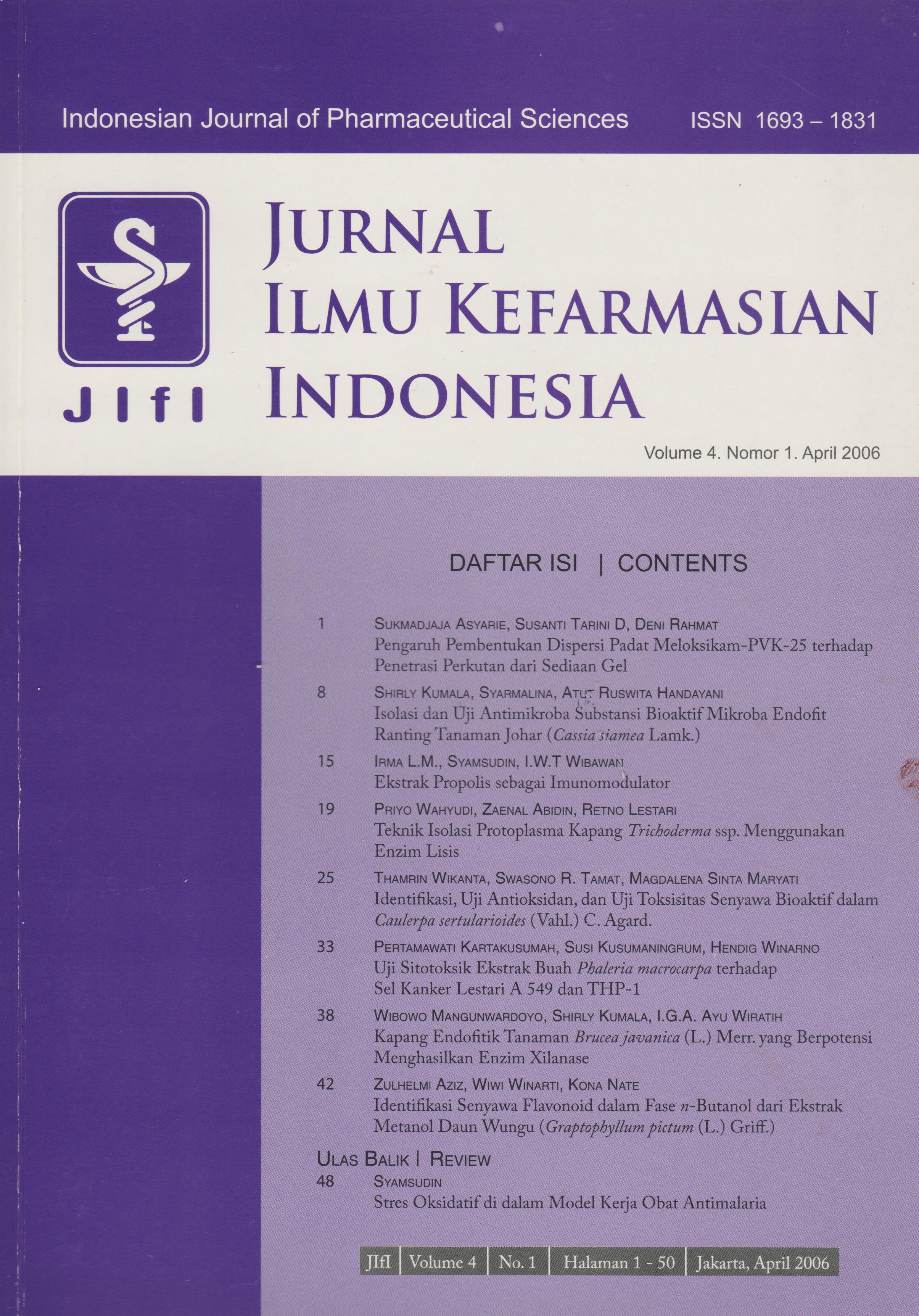
Teknik Isolasi Protoplasma Kapang Trichoderma ssp. Menggunakan Enzim Lisis
Kata Kunci:
Trichoderma, protoplasm isolation, lysing enzyme, protoplastAbstrak
Trichoderma is well known industrial fungi producing many kinds of industrial enzymes and as biological control agent. The applications of modern biotechnology using Trichoderma or its derived metabolites. Considering to the variety of the species of Trichoderma and enzymes or metabolites produced by Trichoderma lead to create a fusan of Trichoderma. The first step toward protoplast fussion is protoplasm isolation. In this experiment has been conducted protoplasm isolation of Trichoderma harzianum, T. viride, T. aureoviride and T. pseudokningii using lysing enzyme in room temperature for 1- 5 hours incubation. The aim of this experiment is to find the best condition and time of incubation in producing protoplast optimally. Trichoderma mycelia (1 mg) sink in osmotic stabilizer solution (pH 5.8), crushed and add 1 ml lysing enzyme 2%, then incubate in shaker incubator (room temperature) for 5 hours. Observation of the protoplast is conducted using haemacytometer for 1 until 5 hours incubation. After 5 hours incubation in room temperature showed the T. harzianum protoplast is the highest number of protoplast (40,150 protoplast/ml), followed by T. pseudokoningii (10,375 protoplas/ ml), T. viride (15,075 protoplast/ml) and T. aureoviride (10,050 protoplas/ml).
Referensi
Unduhan
Terbitan
Bagian
Lisensi
Licencing
All articles in Jurnal Ilmu Kefarmasian Indonesia are an open-access article, distributed under the terms of the Creative Commons Attribution-NonCommercial-ShareAlike 4.0 International License which permits unrestricted non-commercial used, distribution and reproduction in any medium.
This licence applies to Author(s) and Public Reader means that the users mays :
- SHARE:
copy and redistribute the article in any medium or format - ADAPT:
remix, transform, and build upon the article (eg.: to produce a new research work and, possibly, a new publication) - ALIKE:
If you remix, transform, or build upon the article, you must distribute your contributions under the same license as the original. - NO ADDITIONAL RESTRICTIONS:
You may not apply legal terms or technological measures that legally restrict others from doing anything the license permits.
It does however mean that when you use it you must:
- ATTRIBUTION: You must give appropriate credit to both the Author(s) and the journal, provide a link to the license, and indicate if changes were made. You may do so in any reasonable manner, but not in any way that suggests the licensor endorses you or your use.
You may not:
- NONCOMMERCIAL: You may not use the article for commercial purposes.

This work is licensed under a Creative Commons Attribution-NonCommercial-ShareAlike 4.0 International License.