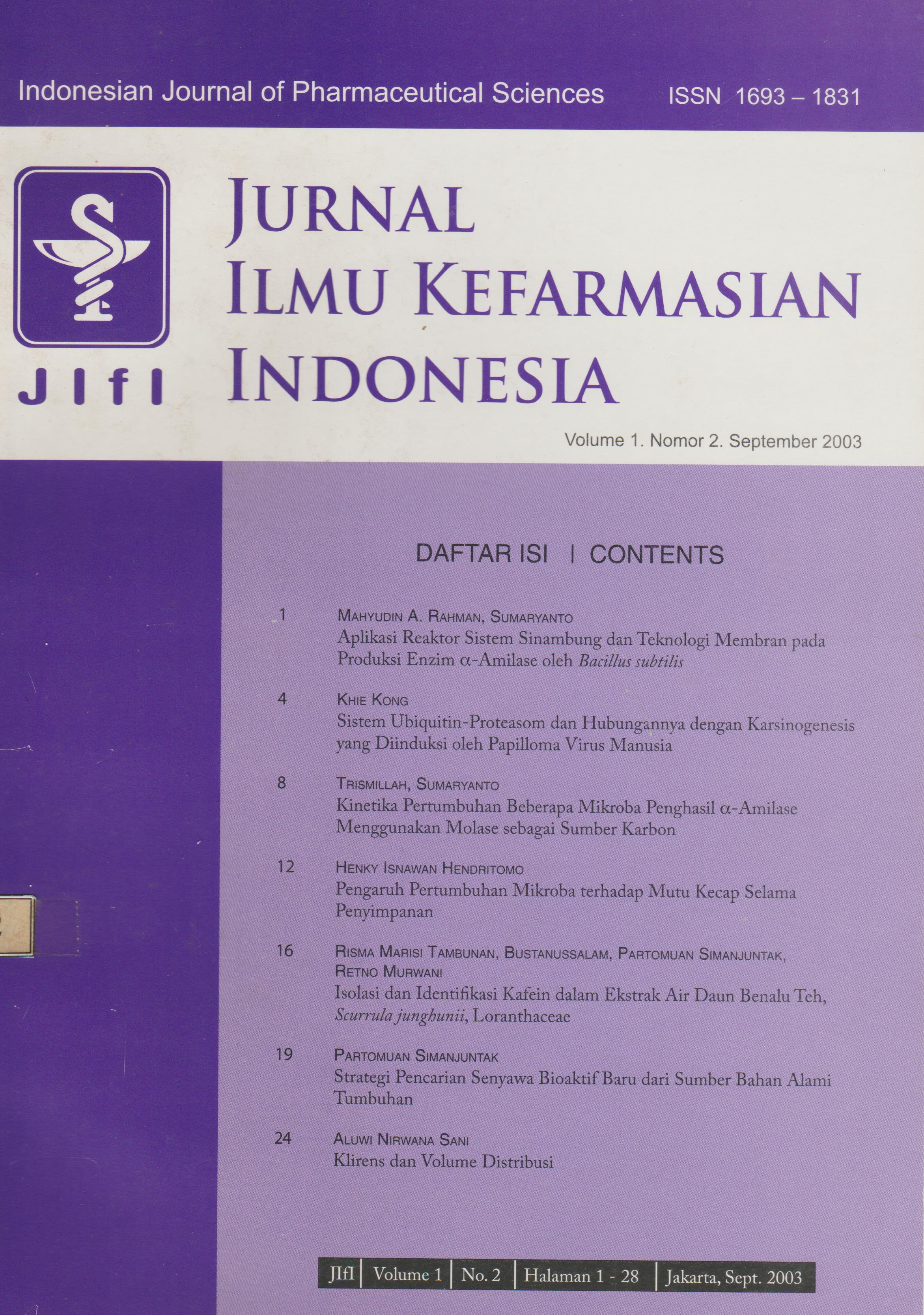
KINETIKA PERTUMBUHAN BEBERAPA MIKROBA PENGHASIL A - AMILASE MENGGUNAKAN MOLASE SEBAGAI SUMBER KARBON
Kata Kunci:
a-Amylase, B. subtillis ATCC 6633, S. fradiae dan Aspergillus niger, activityAbstrak
Molasse as a waste product in sugar industry can be used as alternative carbon source in fermentation, which influences the growth of microbes and production process. In this experiment 5% molasses was used as a medium for producing a - amylase using Bacillus subtilis ATCC 6633, Streptomyces fradiae, and Aspergillus niger. The experiment was done in an Erlenmeyer of 125 ml in a shaker incubator with 250 rpm agitation. The temperature was adjusted to 37°C and the initial pH for Bacillus subtilis ATCC 6633: waste pH=8; Streptomyces fradiae: pH=7, and Aspergillus niger : pH=5. The result showed, that the highest growth and enzyme activity were accomplished by Bacillus subtilis ATCC, while specific growth rate (u max)= 0,1501 in 24 hours attained.
Referensi
Unduhan
Terbitan
Bagian
Lisensi
Licencing
All articles in Jurnal Ilmu Kefarmasian Indonesia are an open-access article, distributed under the terms of the Creative Commons Attribution-NonCommercial-ShareAlike 4.0 International License which permits unrestricted non-commercial used, distribution and reproduction in any medium.
This licence applies to Author(s) and Public Reader means that the users mays :
- SHARE:
copy and redistribute the article in any medium or format - ADAPT:
remix, transform, and build upon the article (eg.: to produce a new research work and, possibly, a new publication) - ALIKE:
If you remix, transform, or build upon the article, you must distribute your contributions under the same license as the original. - NO ADDITIONAL RESTRICTIONS:
You may not apply legal terms or technological measures that legally restrict others from doing anything the license permits.
It does however mean that when you use it you must:
- ATTRIBUTION: You must give appropriate credit to both the Author(s) and the journal, provide a link to the license, and indicate if changes were made. You may do so in any reasonable manner, but not in any way that suggests the licensor endorses you or your use.
You may not:
- NONCOMMERCIAL: You may not use the article for commercial purposes.

This work is licensed under a Creative Commons Attribution-NonCommercial-ShareAlike 4.0 International License.